

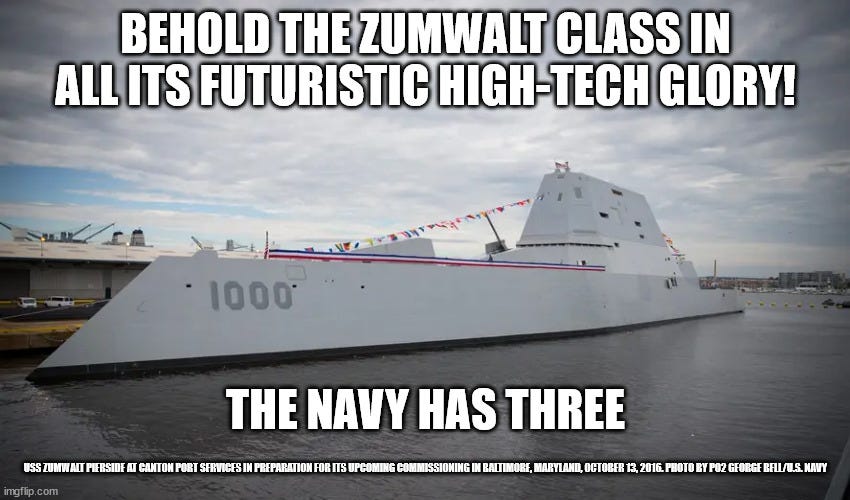
Having highly capable ships is not the answer to the naval power question. Numbers matter.
This analyst discusses Navy force structure issues. He notes that the Navy pays a price for better ships:
To illustrate, an LCS class without such systems costs about $700 million while a Constellation-class frigate, similar in size to LCS but with a SPY radar for air defense, will likely cost over $1.3 billion (PDF). This makes clear that including the capability for area air defense would mean there would have to be fewer ships. Making a ship into a capable air defense platform is the equivalent of half a ship without such equipment. If simple numbers are part of the calculus, air defense capability for a large number of ships is likely out of reach. The exact number of ships that should have this capability requires more analysis than we can provide here. But we can say that not every surface combatant can have this capability, not if there's to be a sustainable and sufficiently numerous surface fleet.
Burke guided missile destroyers are the Navy's primary surface warship. They are still excellent ships. But their design is old. Updating it has limits. I had thought the new Constellation frigates would go in the direction of the old Perry-class frigates—and what the LCS was supposed to be until the LCS crashed and burned—that did not have the Burke’s well-rounded capabilities but were built in large numbers. Instead the new class is a Burke Lite. If it works.
Not every naval mission needs a high-end ship, as the analyst notes. And if we have too many high-end ships, we may not have anything available to send. Oh, we can try for a while. But eventually, again as the analyst notes, over-using the few high-end ships we have will wear them out and put them in port for longer maintenance periods.
Worse, for all the talk of needing 381 ships, there is no reasonable path to getting there:
Over the last decade, Congress and the administration, regardless of party, have not wanted to fund a larger Navy. If the requirement for 381 ships is valid and unattainable, then the nation is at significant risk, especially for Cold War II. So, why is the Navy still pursuing this requirement? By doing so, the Navy is either (1) misleading the nation or (2) unwittingly positioning the United States for a catastrophic defeat in a war with China.
Instead of pursuing this fantasy of 381 ships and putting the nation at risk with an inadequate defense, the current CNO, Admiral Lisa Franchetti, must offer an alternative—a Plan B—that offsets the gap in required ships.
For Neptune's sake, amid that talk of seeking 381 ships the Navy can't even keep 75 of the surface ships we have ready for war!
Eighteen months into its two-year, data-based maintenance plan, the Navy hasn’t yet reached its target to have 75 of its warships as mission capable and prepared to deploy at any time, Naval Surface Forces leaders told reporters.
What could possibly go wrong?
I'll add another short-term measure to those suggested above: modularized auxiliary cruisers.
I have long urged the Navy to pick a number of ships it needs and then build ships with varying capabilities to reach that number within a realistic budget that doesn't rely on massive increases. Failing to to that is no lack of a decision. It is a default decision to have fewer ships than America needs.