

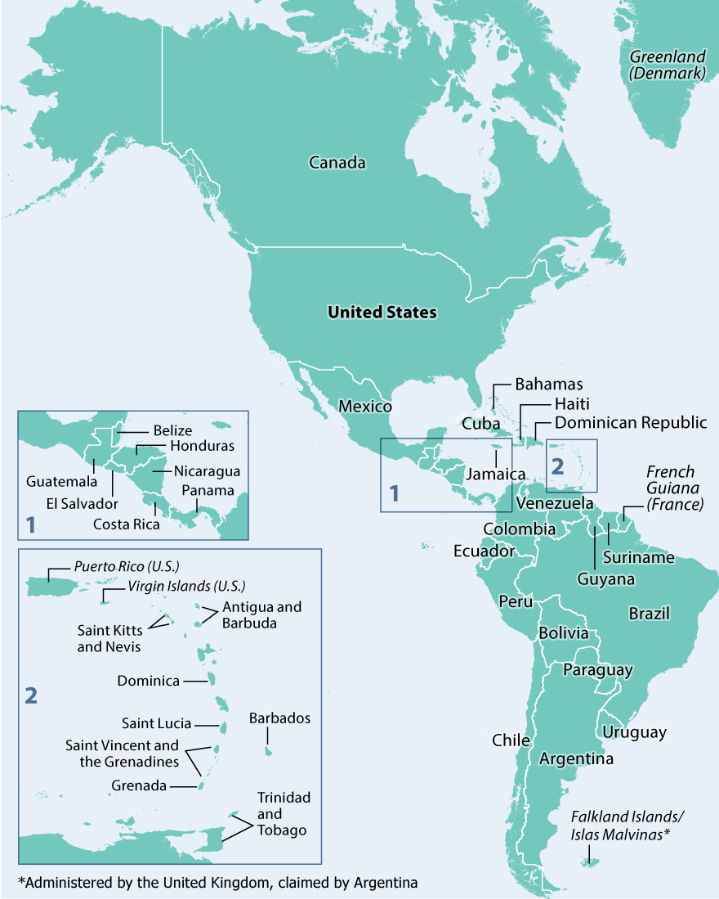
America’s relationship with Latin America has evolved from a Monroe Doctrine sphere of influence to shield us from European interference; to Good Neighbor benign neglect to reject the financial and reputational burden of a sphere of influence; to Cold War ally against Communism globally. And now America wants the relationship to evolve into a mutually beneficial partnership for security and economic growth across the Western Hemisphere, including Canada and Greenland (owned by Denmark).
This Hoover Institution report identifies and discusses three crucial lines of effort for securing the Western Hemisphere:
The most critical choice concerns the relationship between the United States and Mexico. Washington and Mexico City will determine how and to what extent bilateral ties will deepen amid an escalating war against narcoterrorists and the renegotiation of the US-Mexico-Canada Agreement (USMCA).
The second choice regards regime change in Cuba. President Trump vows “Cuba is next” on his authoritarian target list, but the United States must decide how to negotiate the Castro regime’s journey into the dustbin of history.
The third consequential choice relates to America’s strategic competition with China in the hemisphere. The United States must choose how to provide Latin American partners with a viable alternative to Chinese Communist Party (CCP) investment.
These are reasonable points to emphasize for building a foundation of trade, migration, and counter-cartel relationships; closing a gaping hole in hemispheric security that the Soviets exploited and that China can exploit more; and denying China the ability to undermine America’s Western Hemisphere partnerships.
This sizable report to Congress on American foreign policy in the Western Hemisphere is useful. These are the primary features of American Western Hemisphere policy:
• Competition with China and Russia. The Administration has placed renewed emphasis on limiting the influence of extra-hemispheric powers in the Western Hemisphere. This approach has included U.S. efforts to secure or enhance access to locations the Administration deems strategic, such as the Panama Canal and Greenland, and to prevent competitors from controlling critical infrastructure in the region.
• Counternarcotics and Transnational Crime. The Administration has increased the U.S. military’s involvement in combating illicit narcotics and addressing related security challenges. This approach has included designating transnational criminal organizations as terrorists, conducting unilateral lethal strikes on suspected drug traffickers, and executing the January 2026 U.S. military capture of then-Venezuelan leader Nicolás Maduro.
• Migration Policy. The Administration has focused extensively on stemming unauthorized immigration into the United States and removing unauthorized immigrants from the country. Among other actions, the Administration has imposed new restrictions at the border, ended humanitarian protections that had provided relief from removal for some immigrants in the United States, and negotiated agreements with governments to accept increased repatriations and third-country migrants from the United States.
• Trade Policy. The Administration has implemented tariffs on imports from Western Hemisphere countries—including free-trade-agreement partners—tied to various economic, security, and political goals. The Administration also has pursued bilateral trade negotiations to lower foreign tariffs and nontariff barriers and to potentially expand Western Hemisphere supply chains in strategic sectors.
• Political Engagement. The Administration has scaled back democracy assistance in Latin America and the Caribbean while offering support to some politically aligned leaders in the hemisphere. The Administration also has increased U.S. pressure on the authoritarian governments of Venezuela, Cuba, and Nicaragua, while sometimes prioritizing economic or other U.S. objectives over democracy and human rights.1
How do our hemispheric neighbors view this?
Western Hemisphere governments have reacted to these policy shifts in various ways. Some governments have fully embraced the Trump Administration’s approach, adopted similar policies, and sought to collaborate more closely with the U.S. government. Other governments have demonstrated a willingness to negotiate with the Trump Administration and cooperate in certain areas while rebuffing the Administration in others. U.S. actions perceived to threaten Western Hemisphere countries’ economic interests and sovereignty, such as levying tariffs, imposing sanctions, and threatening to use unilateral U.S. military force, appear to have generated particular pushback and contributed to some countries seeking to bolster ties with other partners.
I addressed a number of relevant issues in this essay:
The Enduring Threats to America from Europe

America has interests in Canada , Greenland, Mexico, the Panama Canal , the Gulf of Mexico, and of course the Atlantic, which actually is an anti- political “Europe” moat—not a geographic anti-European moat.
Russia is a minor threat, honestly. They have a lot on their plate in Europe now in their self-inflicted wound that is bleeding their military and economy even as the invasion of Ukraine inspires the long-comatose Europeans to rearm. Russia should worry about China:

And Russia’s efforts in Africa seem more about earning cash and pretending Russia is a global power and not a regional power with continents-spanning security burdens:
The End of the Russian Decline Era

We are completing the era between the end of the Cold War beginning in 1989 when the Soviet empire started to fragment and the Winter War of 2022 when Russia’s power was proven to be hollow for a country with great power ambitions. The Era of Great Power Competition already proclaimed will develop with the reality that the era with the placeholder name …
What I concluded in that Enduring Threats essay is a reminder that America is not retreating to Fortress America isolationism:
Ultimately, Trump reminded us that homeland defense isn’t a matter of sitting in bunkers on our coasts and land borders watching for a threat to reach us. And if we have friends abroad willing to cooperate with us for mutually beneficial reasons, homeland defense is strengthened in a stable way unlike empires that conquer vassals for use as expendable buffer states.
The Western Hemisphere can be an expanded secure base for American power projection capabilities to hold the line in Eurasia:
The Good Neighbor Policy 2.O

The Western Hemisphere was America’s first line of defense when the Monroe Doctrine was first announced. But experience and growing power showed that real homeland defense has to be carried out with ground and air power on or just off the far shores of Asia and Europe
Such a foundation reduces American reliance on strategically important raw materials acquired in Eurasia. That will increase American freedom of action without being blackmailed into inaction by hostile states controlling key raw materials.
The National Security Strategy focuses on the Western Hemisphere:
Our goals for the Western Hemisphere can be summarized as “Enlist and Expand.” We will enlist established friends in the Hemisphere to control migration, stop drug flows, and strengthen stability and security on land and sea. We will expand by cultivating and strengthening new partners while bolstering our own nation’s appeal as the Hemisphere’s economic and security partner of choice.
And this focus is not merely rhetorical or diplomatic. It means that AFRICOM’s unofficial motto can’t be “Thank God for SOUTHCOM” which now has real military resources available in Latin America:
The United States must reconsider our military presence in the Western Hemisphere. This means four obvious things:
• A readjustment of our global military presence to address urgent threats in our Hemisphere, especially the missions identified in this strategy, and away from theaters whose relative import to American national security has declined in recent decades or years;
• A more suitable Coast Guard and Navy presence to control sea lanes, to thwart illegal and other unwanted migration, to reduce human and drug trafficking, and to control key transit routes in a crisis;
• Targeted deployments to secure the border and defeat cartels, including where necessary the use of lethal force to replace the failed law enforcement-only strategy of the last several decades; and
• Establishing or expanding access in strategically important locations.
Canada and Greenland are strategically important locations for defending the Western Hemisphere from the north:

One angle that isn’t mentioned in the Western Hemisphere report to Congress is Iran. Which is odd given that Iran supported Maduro and its proxy Hezbollah has tentacles throughout the Western Hemisphere.
I was wrong a year ago about Maduro not being the target of our military deployments. But I do wonder if the ongoing drug strikes are just as much about hurting Hezbollah’s Western Hemisphere financial empire (and indirectly, Iran) as it is to slow down drug exports to America:
The terrorist organization Hezbollah has a presence in more than 40 countries worldwide. Its presence in Latin America is of growing concern, especially in Brazil, Colombia, Ecuador, Panama, and Peru. For decades, one of the most active regions for this terrorist group has been the Triple Frontier between Argentina, Brazil, and Paraguay, where security forces have found explosives and evidence of the group’s financing through narcotrafficking, German broadcaster DW reported.
So that’s one area that I would like to see given more emphasis. Certainly a Venezuela no longer under Cuba’s thumb and reliant on Russia and Iran for support helps undermine Hezbollah. But Venezuela is a difficult project even if it avoids the pitfalls of direct military occupation:

Perhaps counter-terrorism and counter-cartel features of American policy naturally encompass erasing Hezbollah’s presence and ability to fund their Middle East terrorism that hampers America’s ability to step back from our military posture in CENTCOM.
America has a new policy for the Western Hemisphere that comprises a whole-of-government approach newly reinforced with military and top leadership attention and resources. There are a number of objectives to achieve before we establish it as a foundation of American power. Teaming with Mexico, neutralizing Cuba, and squeezing China out of key roles are challenging objectives. And if achieved, friction with the rest of Latin America will decline, creating a positive cycle.
When this foundation is established, it will naturally have to be defended as enemies seek to distract us from Eurasia with problems nearer to our homeland. But a secure Western Hemisphere foundation will be key for global intervention when necessary to assist allies and friends that have stood up to defend themselves from our common potential enemies.
NOTE: Map from the CRS report.
Perhaps this is true in the short run. But in Venezuela, after removing Maduro, America does seem to be nudging the government toward rule of law and democracy. A pairing vital for functioning democracy, economic growth, and stability.