

China has four military modernization vectors that threaten American interests in the western Pacific. Don't forget that Russia has reasons to worry, too. As the axiom notes, intentions change while capabilities are more predictable. Russia alarmed NATO while giving China dangerous options against that weakened power.
Russia was obsessed with Ukraine while it ignored the Far East. But Putin’s ground forces didn’t match his beliefs about it, and Ukraine has pretty much destroyed the original force, even the paratroopers. So now Russia is arming up:
ISW recently observed reports indicating that Russia is actively expanding and stockpiling its production of T-90M tanks, and Russia's expansion and acceleration of missile production capacity further supports ISW's assessment that Russia is working to expand its defense industrial base (DIB) likely in preparation for a protracted war in Ukraine and a potential expanded future conflict with NATO.
Russia is also accelerating ICBM modernization and apparently stockpiling shorter range Iskander cruise missiles and ballistic missiles. ISW earlier reported this claim:
Russia has 13 divisions and an unspecified number of regiments and brigades (totaling roughly 121,000 troops) in its strategic reserve.
And while Russia’s apparent decision to rebuild forces without committing them to the invasion of Ukraine has been interpreted as a threat to NATO, it could be that rebuilding a strategic reserve can no longer be put off if Russia is to contain China’s potential threat to Russia’s Far East (quoting an article):
The Russian-Chinese Treaty of Good Neighborliness, Friendship and Cooperation that expires in July 2021 will be extended for another five years with its basic provisions remaining intact, while introducing some modifications, the Russian ambassador in Beijing, Andrey Denisov, said on Tuesday.
Rarely does a week go by without more grim news about China’s growing military power and the deteriorating strategic balance in Asia. Projections of the People’s Liberation Army (PLA) into the 2030s, assuming deterrence holds between now and then, suggest that the operational environment will be even more hostile to the U.S. armed forces and those of its Asian allies. ...
During the exercises, the debates that took place among leading thinkers and practitioners in the United States and Australia surfaced a range of PLA modernization trends that will likely have significant implications for allied deterrence and warfighting over the next ten years. Four areas stood out for their likely strategic and operational impact—namely, China’s shore-based firepower, anti-submarine warfare, global power projection, and theater nuclear capabilities.
China's advances in those four capabilities should also concern Russia. Not everything is about America. The Australians could use a similar revelation.
Right now, China is Russia's frenemy with temporary benefits. Fully ending China's "Century of Humiliation has to go through Russia to reverse that massive stain on China's honor and long dominance of the eastern edge of Asia:
China's communists take pride in restoring China from their nadir of humiliation at the hands of the Europeans. Western enclaves in China's ports where Western law was supreme and actual formal loss of territory to Europeans like at Macao and Hong Kong added to the pain.
But China has regained control of their coasts, including the former colonies. China has no actual territorial disputes with America or Europe.
That is not the case with Russia, the last European state to control territory seized from China when it was weak. China isn't shy about claiming other land. Why would Russia be the exception?
As Russia demonstrates its limits as an ally by self immolating in Ukraine, China may consider whether the time for pouncing to loosen Russia's control of the Pacific Far East has unexpectedly arrived. Recall that Iraq was tempted into hitting its long-time foe Iran while it had a chance after the Iranian Islamist revolution and the rise of the mullahs crippled Iranian military power.
Regarding shore-based firepower, the article notes missiles and bombers able to reach sea and land targets, including the newly developed H-20 stealth strategic bomber that "will offer a new shore-based instrument to deliver Pacific-wide firepower." This capability surely threatens American and allied ships and bases even 5,000 miles away. But that's a very deep anti-access/area denial (A2/AD) envelope that China could extend into Russia's territory in Asia. Like on the Trans-Siberian Railroad.
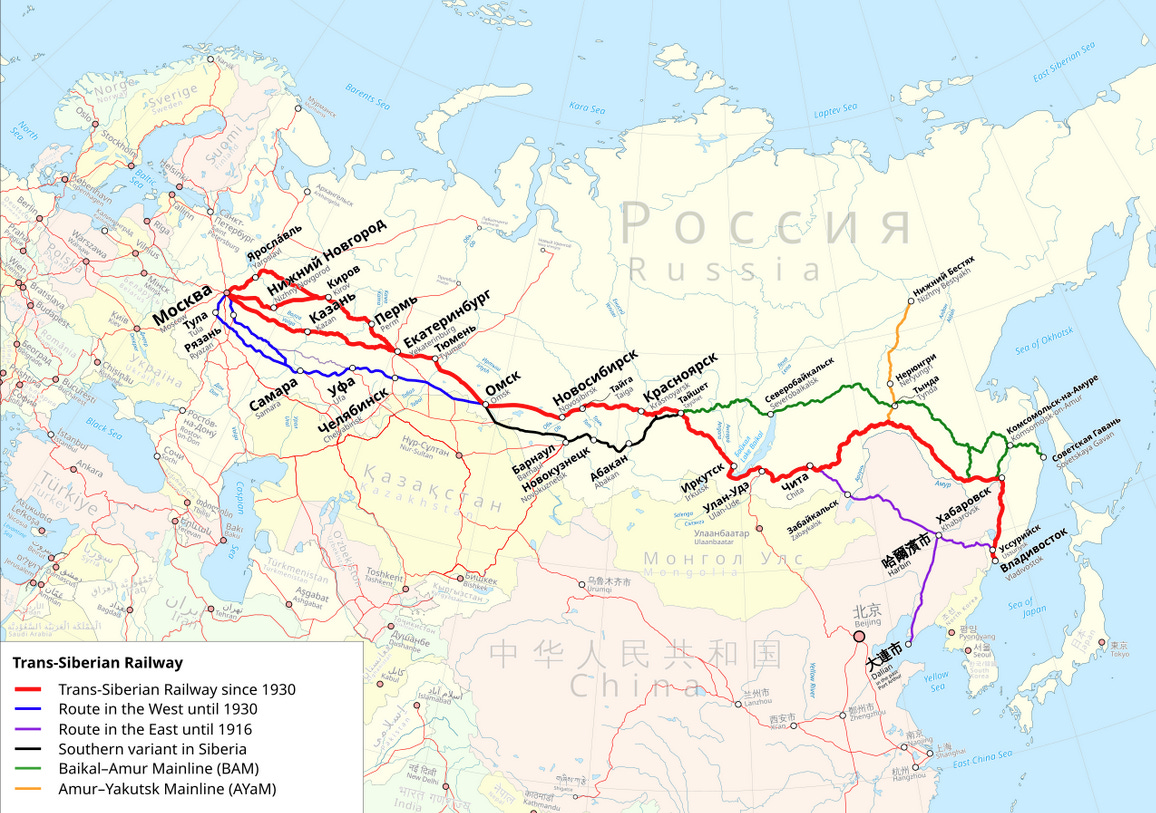
As I've noted before, we're so vain to think China's missiles are necessarily about America.
Regarding anti-submarine warfare, of course these threaten American and allies submarines trying to operate within the Chinese A2/AD envelopes where surface ships face more dangers. But that applies to Russian subs, too, one of the few blue water capabilities the Russians finance.
And it gets worse for Russia when you consider that a Sea of Okhotsk SSBN bastion is crucial for Russian nuclear deterrence. China's growing anti-submarine capabilities threaten Russia in a vital way that they don't threaten America.
As for global power projection, this seems more like a peacetime capability to support Chinese economic interests globally. Says the article on the CSBA exercise:
According to a U.S. Navy projection, the PLAN is expected to have five carriers, 60 cruisers and destroyers, 135 frigates and corvettes, four LHAs, 14 LPDs, and 24 LSTs by 2030.
Yes, if China breaks through the first island chain which in the hands of countries friendly to America constrain China's wartime access, the ability to operate deeper into the oceans is significant in regard to American interests. Made all the worse by losing the military power of those first island chain allies, obviously. But Russia is huge, spanning Eurasia. If China can project power globally, European Russia isn't safe the way it was when it waged war on Japan in the Russo-Japanese War over a century ago.
China could afford to spare a small part of its fleet away from its coasts to crush any Russian ships on the loose and to hammer Russian merchant ships and tankers.
Finally, theater nuclear capabilities. China needs strategic nuclear missiles to threaten America, either land-based or submarine-based close enough to strike the continental United States. Threats to Alaska, Hawaii, and Guam are threatened by theater weapons, as are American allies. But shorter-range nuclear weapons are strategic weapons to hold Russia targets "at risk" even if geographically they are on the other side of their border at theater or even tactical ranges.
In part, the essay on the CSBA exercises concludes:
For policymakers in Washington and allied capitals, these developments collectively raise troubling questions about acceptable risk to U.S. forces operating west of the international date line, the prospect of fighting a multi-theater campaign against a globalized PLA, the growing pressures on U.S. extended deterrence in Asia, and the risks of nuclear brinkmanship and escalation in a crisis or a war.
What about the acceptable risk for Russian forces operating inside Russia?
It kind of cracks me up when I read essays like this one that reflects on three recent setbacks for Russia’s strategic deterrence as a result of its invasion of Ukraine:
Together, they represent something more dangerous: a full-frontal collapse of Russia’s reputation as an untouchable military power. And if Russia’s deterrence posture can be exposed that easily, what does that mean for China?
That is, what does it mean for China in the sense of whether it, too, could suffer from similar setbacks that reduce its own strategic deterrence.
But what about the effect of Russia’s faltering strategic deterrence on China’s view of Russia? China is supposed to worry about what it could lose in a war with America and its allies over Taiwan. But maybe rather than fight America, China will decide it would rather take down Russia. A Russia whose strategic deterrence is already crippled:
[The] Chinese are talking about taking back most of the Russian Far East province and renaming cities like Vladivostok with their original Chinese names like Yongmingcheng. This was a Chinese city that had been in this location for over a thousand years until the Russians forced China to surrender the territory to them in 1859 and renamed Yongmingcheng as Vladivostok.
China wants its stolen territories back and Putin fears that while Russia is busy in Ukraine the Chinese might make a move.
I read that China is becoming more important to sustaining Russia’s war effort. If China is thinking about alternatives to fighting America to demonstrate their power and claim global status, maybe that Chinese aid is designed to be enough to allow Russia to keep self-immolating in Ukraine. Maybe China is getting revenge for Russia’s efforts to distract China in a war against America.
I suspect that in 2022 Putin intended to quickly crush and occupy Ukraine with the side effect of intimidating NATO; which would allow Russia to pivot east with a potent military reputation bolstering his strategic deterrence before his non-aggression pact with China expires. As that hope was exposed as hollow, I thought the best Russia could achieve was wrecking Ukraine to pivot east. Putin got neither.
And Russian intelligence officers “fear that Chinese academics are laying the groundwork to make claims on Russian territory.”
Of course, China's capabilities are capabilities. And America and Australia, which hosted the exercises noted above, must cope with the capabilities China is building. But understanding China's full range of options—against Russia, too—could open opportunities to change those Chinese intentions even as their capabilities improve with little that can be done to change the capabilities other than by balancing them with friendly capabilities.
I have hopes America could achieve that kind of dramatic shift in Chinese intentions via Russia—perhaps by redirecting rather than reducing Russian paranoia. As Russia reconstitutes its military, will it also reconstitute its strategic myopia that pretends NATO is a threat and China is a partner without limits?
Russia has some hard decisions that it may not be able to put off for much longer.
NOTE: I made the top image with the Substack capability. The map is by OpenStreetMap: OpenStreetMap contributersNatural Earth: Tom Patterson, Nathaniel Vaughn Kelso and other contributorsMap rendering: Pechristener using QGIS - Map was created using:Open Street Map Data for Railway Lines & TownsNatural Earth for 1:110m Cultural Vectors used for Country Borders & Coastlines, ODbL, https://commons.wikimedia.org/w/index.php?curid=84020385