

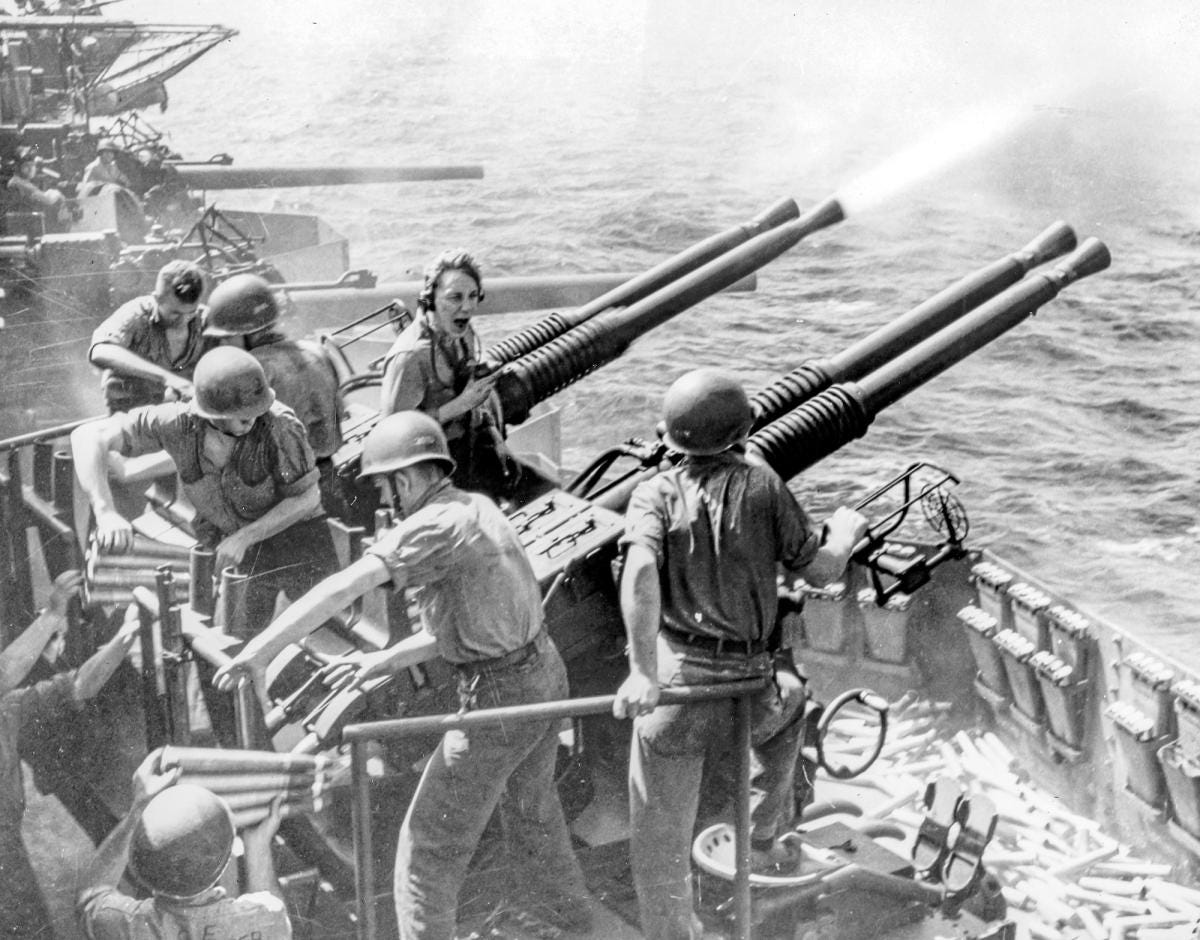
World War II warships had more and more air defense guns added to them to cope with air attacks. Kamikaze attacks sorely tested those defenses as American forces closed in on Japan itself. I’d rather have an area electronic warfare shield. But I suspect cheap mass kinetic defenses are needed for cheap mass attackers.
The U.S. Navy is leaning heavily into palletized and containerized solutions for additional firepower on lightly armed surface combatants. The U.S. Navy’s Littoral Combat Ships, long considered under-gunned for a near-peer conflict, are one of the main recipients of containerized weapon systems for this purpose. Other ships, like expeditionary sea bases and amphibious assault ships, could get containerized guns that can roll out from hangars to provide air defense during complex attacks, adding to the point defense and precision kill capabilities of the entire fleet.
BAE Systems has recognized the emerging need, pitching their 40mm Bofors 40 Mk 4, alongside other solutions, as a suite of options for a U.S. Navy interested in firepower that can be quickly onloaded and offloaded from any ship in the fleet.
The 40mm round has a proximity fuse, too.
The Navy is deploying land-based anti-drone weapons on its ships for the Red Sea station:
The Navy says it is working to reduce the growing costs of fighting Houthi drones launched from Yemen by placing two new experimental systems on destroyers that are slated to deploy later this summer.
"We're going to be deploying the Ford strike group with two additional missile systems on our destroyers -- the Roadrunner system and the Coyote system -- both specifically designed to go after UAVs," or unmanned aerial vehicles, Adm. Daryl Caudle, the commander of U.S. Fleet Forces, told reporters last week.
Ever since the Navy repelled its first wave of drone attacks from the Houthi rebels in October 2023, there has been a steady criticism over the fact that commanders were turning to multimillion-dollar missiles to down drones that cost fractions of that amount. The phenomenon became known as the "cost-curve problem."
Roadrunner is a reusable, vertical take-off and landing (VTOL), operator-supervised Autonomous Air Vehicle (AAV) with twin turbojet engines and modular payload configurations that can support a variety of missions.
Roadrunner-M is a high-explosive interceptor variant of Roadrunner built for ground-based air defense that can rapidly launch, identify, intercept, and destroy a wide variety of aerial threats — or be safely recovered and relaunched at near-zero cost.
And Coyote:
Small and expendable, Coyote C-UAS kinetic and non-kinetic variants are able to defeat small to large target unmanned aircraft systems at longer ranges and higher altitudes than similar class effectors. Raytheon’s Coyote C-UAS scan defeat single drone threats as well as swarms, supported by reduced engagement timelines to defeat multiple targets.
But putting more air defenses on the carriers still leaves the carriers too close to the action:
Truman was conducting an “evasive maneuver” during the incident, a U.S. defense official confirmed to USNI News on Monday. A second defense official told USNI News the Super Hornet was being loaded onto the aircraft elevator on Truman when the strike fighter slid over the edge.
U.S. ships in the Red Sea are daily targets of Houthi one-way attack drones and cruise and ballistic missiles since U.S. strikes against targets in Yemen resumed on March 15.
To me, those new systems seem like they should be on a long-endurance A-Whacks on combat air patrol over the Navy ships:
Aerial drones fired by the Houthi are straining the ability of our Navy to protect the sea line of communication through the Red Sea. And Iran's massed drone and missile attack on Israel required lots of expensive defensive systems to smash up. Could a combination AWACs/missile truck plane provide a cheaper defense than expensive Standard missiles launched from surface ships?
I had suggested the 70mm Vampire guided rocket. But perhaps these suicide drones would be better. Or maybe a collection of all would provide overlapping capabilities. The large planes would function as a loitering forward detection and air defense line for surface task forces.
For even more endurance, could the Navy replicate the old picket destroyers that detected and distracted incoming kamikaze waves? I've suggested air defense modularized auxiliary cruisers using containerized systems posted between the main task force and the enemy drone and missile defenses:
Could there be a role for modularized air defense auxiliary cruisers in getting that volume of fire? I addressed Navy use in this post (originally submitted as an article many years ago) along with Army missions (calling the ship The AFRICOM Queen for its intended area of operations) in this Military Review article.
The container ship could be modified with plentiful generators to power as many directed-energy weapons as are needed. The directed-energy weapons and generators could be installed in standard shipping containers to make it easier to configure the modularized auxiliary cruiser. Other weapons might be appropriate as well for limited attack capabilities against surface targets and close-in-weapons systems.
In shipping containers, the systems would also be easier to remove from a damaged modularized auxiliary cruiser to rapidly equip another hull.
Can the Navy Integrated Combat System incorporate all the weapons being developed and carried on dispersed surface and air platforms? Can it handle the volume that drone swarms add to the detection and deconfliction load?
Of course, fighting the threats earlier in the kill chain will make the air defense burden lighter.
I guess my main worry is that putting the Road Runner and Coyote—and especially the 40mm gun—on surface ships pushes the Navy to rely on last-ditch ship point defenses like C-RAM or Phalanx—and hard maneuvering. But if that’s the way it is, it means the Navy needs more gun-based systems using cheap shells with precision aiming rather than expensive and hard-to-reload precision missiles to defend surface ships.
NOTE: Photo from USNI.