

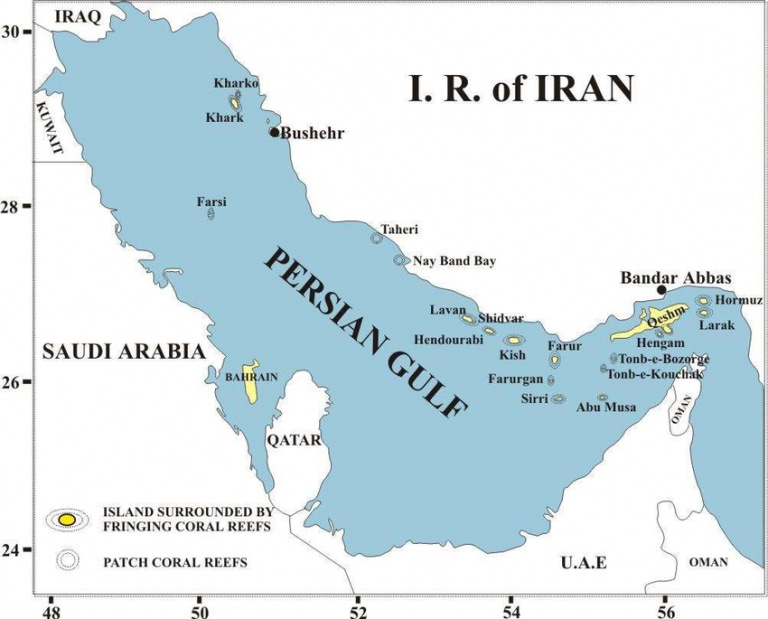
An author makes a good case for American and Arab forces to eject Iranian troops from key Persian Gulf islands that allow Iran to interdict traffic through the Strait of Hormuz. But then he goes and ruins the ride. He says we or our allies must not occupy them and spends a lot of time arguing the legality of that. As if occupation adds anything of legal significance to using military force to eject the Iranians. Good grief, even if illegal this isn’t a violation of the rules of war. And as if occupying the islands isn’t militarily useful to America and our coalition for holding the strait open.
The United States should degrade Iran’s ability to defend and employ Abu Musa, Greater Tunb, and Lesser Tunb as military positions. Afterwards, an Arab-led coalition should temporarily administer and demilitarize the islands while U.S. military power remains available as an external deterrent. Such an arrangement could prevent the regeneration of Iranian maritime coercive capabilities without determining the islands’ ultimate sovereignty.
The purpose would be limited: pacify the islands without annexing them and create conditions under which responsibility for security in the Strait can pass to the regional states that depend upon it.
Ideally, the author wants the neutralize the island without occupying them, trying to get the garrisons to surrender after their military assets are destroyed. That way, the author believes, Iran couldn’t rapidly reconstitute the threat that armed garrisons on the islands can pose to sea traffic.
The islands, claimed by the UAE but occupied by Iran since 1971, have been on my radar a long time:
Saddam Hussein wanted to take these islands as part of his 1980 invasion of Iran, in order to solidify Sunni Arab support for him against the Shia Persians. Saddam cancelled the mission and as he ran into difficulties, the Arab world never did really rally to Iraq's side as combatants against Iran. The Arab world quietly supported Iraq, but Iraq bore the human and financial costs of the war.
Should there be a conflict with Iran, I'd think these islands would be a likely target of our Marines to help secure the sea lines of communication through the Gulf.
I wonder if an agreement to restore them to their Arab owners would help solidify active and open Gulf Arab support against Iran should it come to open US-Iran conflict?
The problem is whether the Arab Gulf states would cooperate, especially the UAE to bless a multi-national effort. And participate in the military operations. Back when I wrote that post the assessment was that the UAE’s naval power alone would be stronger than Iran’s by 2015. We are well past that time. And America decimated Iran’s navy earlier this year.
And shortly before the America-Israel air campaign began I raised the same Gulf possibilities:
Gulf Arab states in the Saudi-led Gulf Cooperation Council may be able to act, with the UAE taking the lead on their three islands. The Saudis could take Sirri Island. A common enemy might heal some wounds. U.S. Marine units with special forces assistance could take Larak Island and the naval base on Qeshm Island.
Yet even limited American ground operations on Iranian islands could become an unwelcome lengthy standoff if the mullah regime in Iran does not fall under pressure internally or comply with our demands from single-domain military action (air) and economic pressure. In the Earnest Will escort missions during the Iran-Iraq War, America was saved from an open-ended naval mission by events on land:
The combination of Iraqi battlefield dominance and Tehran’s perception that America was willing to stop at nothing to crush Iran led the Ayatollah Khomeini to accept U. N. Resolution No. 598, which called for an end to the war. On July 16, 1988, Iran formally accepted the resolution.
That Arab division of labor for seizing Iranian-occupied islands would allow America to withdraw troops once the crisis is resolved one way or another—whether the mullahs fall or just get weakened by a punitive mission—while Arab states could hold the islands they stand on to get the UAE islands back by holding Sirri Island as a bargaining chip.
The author of the initial article spends too much time worrying about the legalities of determining ownership. If Arab states are willing to occupy them and deny them to Iran, that’s enough during the war. And bargaining chips for our side. Leave the status to the diplomats during negotiations.
Remember too that Iran has been occupying the islands for 55 years without being overly concerned about the legality.
And even if illegal, occupying them during military conflict is hardly a violation of the rules of war. They are already misunderstood enough (with a handy video embedded in the essay) without adding to misinformation:

That initial author is on board my view about the need to keep America from being the occupying power:
The underlying principle is straightforward: security on the Arab side of the Gulf should increasingly become an Arab responsibility. American military power should support regional security institutions rather than substitute for them indefinitely. An Arab-led coalition administering the islands, supported by regional maritime forces and backed by American deterrence, would reflect that division of responsibility. …
The coalition would administer and monitor the islands. Regional states would increasingly secure the surrounding maritime environment. American military power would remain available as a strategic backstop.
This arrangement offers an alternative to abandoning the islands after destroying their military infrastructure or turning a limited security operation into an indefinite American occupation.
Even if we help capture any of the islands, America shouldn’t occupy them. I heartily agree. Yet I don’t think that it is safe to simply empty the islands of Iranians to “administer” from afar and “monitor” them, counting on our ability to prevent Iran from re-occupying them. Again, stop worrying about legalities of occupation. Iran will find a way to retake the undefended islands even if it takes surrounding a Revolutionary Guard military expedition with a kindergarten class.
When you start to take Iran’s Gulf islands, take Iran’s Gulf islands. The islands taken from Iran must be occupied for making the decision to drive the Iranians out make any sense. We can use the islands as shields to protect Gulf traffic, with surveillance systems and shorter-range weapons—helicopters, UAVs, USVs, and HIMARS—to project firepower to other islands still held by Iran and to Iranian bases on the shores of Iran’s mainland. And to spot any sea mines that Iran manages to slip into the shipping channels.
Putting Arab states on the firing line on the Gulf islands rather than administering them on paper and monitoring the water and air space around them would also tend to bind the Arab Gulf states to our side in the face of Iranian hostility. We may get less of the tentative nature of their support for military and financial operations against Iran and more of a full desire to defeat Iran.
Which is why it may be very hard to persuade them to join in such an operation, I admit. They like options in a dangerous part of the world. I get that. But it would be very useful to America if we are on a longer-term blockade to squeeze Iran into submission:
Blockade is a Continuation of War By Other Means

Blockading an enemy as America has been doing to Iran is hardly a new thing in the annals of war. Let’s recall the post-World War I situation. Of course, the Treaty of Versailles is another relevant example at the end of the process. That has a lesson, too. Although not the one commonly thought.
And if we don’t have the time from internal opposition to persisting in the blockade and squeeze, taking those islands from Iran will inflict more harm in what will be a punitive mission prior to resuming the overall war at a future time, as I wrote in that essay cited earlier written just prior to the war:
It is true that Iran’s mullahs will define surviving an air campaign as a victory. On the other hand, the mullahs have been at war with America (the “Great Satan”) since they took our Tehran diplomats hostage. The mullahs don’t define their victory in this long conflict as our immediate destruction. Hurting the mullahs may have to be sufficient for America. For now.
Still, we can’t be misled into thinking that successfully squeezing Iran to agree to a deal we find acceptable will end the war if the mullahs are still in charge. They will immediately seek to undermine the terms of even a good deal. It may be useful to do anyway as one campaign in the 47-year war. But that just means our war effort against Iran has to continue without delusions that a deal means we won the war to keep mullah-run Iran from deploying nuclear weapons.
Taking islands from Iran certainly isn’t a silver bullet solution to the Iran problem. But if this is just a campaign in the long war, even just holding those islands past this round will strengthen the hand of Iran’s enemies to contain the Iranian threat in the short run.
Might the Mecca accords tying Saudi Arabia to Turkey and Pakistan in a military defense pact be brought in to provide cover for the small Gulf Arab states to actually occupy Iranian-held islands in the Gulf?
NOTE: The map is from Maritime Education.

I'm totally with you on the absurdity of "administering" the islands from afar without actually occupying them... that sounds like a recipe for a ghost garrison situation where the IRGC just slips back in the second our backs are turned. But do we really trust the Saudis to hold Sirri Island without cutting a separate deal behind our backs?