

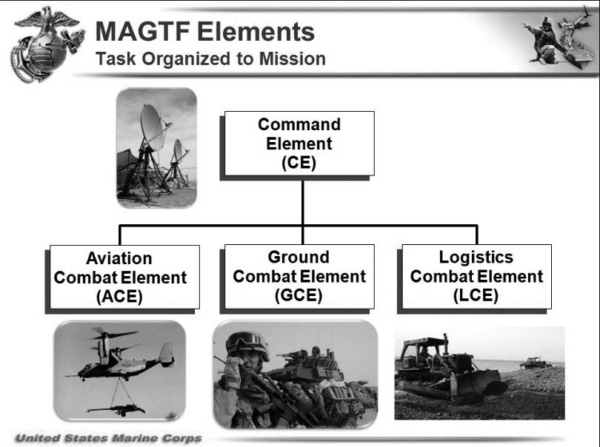
The Marine Corps leadership desperately wanted to be something other than a second United States Army. So it abandoned its Army stuff and embraced being a land Navy that fights ships (so a third Navy after the Coast Guard, eh?). And then the Army raced ahead of the Marines in getting rid of the Army stuff its infantry uses. God help us all, but I think I see where the Marine Ground Combat Element (GCE) 2040 path is leading.
Brace yourselves, the Marine Corps introduced GCE 2040. I’ve already expressed my concerns about the original Force Design 2030 (now just Force Design, kind of like “Madonna” or perhaps “The Weekend”):
Tearing Apart the Marine Corps

In its zeal to avoid being a redundant second Army, the Marine Corps has done to itself with Force Design what no enemy has been able to achieve—destroyed it as a combat force.
And I’m not happy about the ship (the Landing Ship Medium, LSM. a.k.a. "barge with pretensions”) that is supposed to move Marine detachments around the western Pacific within China’s weapons engagement zone:
Hey! APD!! APD!!! APD!!!!

Will the Littoral Combat Ship (LCS) find salvation by enabling a Marine Corps combat mission in the South China Sea littorals?
None of those concerns have been properly addressed to my satisfaction. Or to the satisfaction of a lot of Marines who know a lot more (as in orders of magnitude more) about this issue than I do. “Nah, it’ll be fine” just doesn’t cut it. But those were the initial ground rules for the ground combat elements that were gutted to build a couple Marine Littoral Regiments (MLRs).1
And at the risk of digressing, couldn’t the Marine aviation combat element been assigned the anti-ship mission that MLRs were built to do?
Marine Aviation Force Design

Marine aviation is demonstrating how it could have contributed to Navy anti-ship missions without gutting the Marine Corps for ground combat missions. Red (kinetic) and Green (non-kinetic “effects”) Wolf missiles illuminate an alternate path.
And don’t get me started on asking why the Navy Expeditionary Combat Command wasn’t tasked with deploying anti-ship missiles supported by conventional Marine units.
Serenity now.
Now it is time to figure out how Marines fight without tanks, tube artillery, engineers, and all the other stuff that made Marines effective in ground combat from 1945 to … well, Force Design 2030. So I present the U.S. Marine Corps Ground Combat Element (GCE) 2040 Initiative:
In June 2026, the Marines released Ground Combat Element (GCE) 2040 for FY2026. As part of Force Design, GCE 2040 is intended to provide a roadmap for further transformation of Marine ground combat forces.
Okay. So this report isn’t about Marine ground combat forces. You know, actual combat units. It’s about the transformational journey there. How very … zen.
Also, the Marines apparently haven’t been transformed enough already by stripping them of tanks, tube artillery, engineers, and other assets for combined arms operations. So there will be further transformation. Good and hard. Which apparently means the Marine units stuck between the 2020 and 2040 plans cannot conduct combined arms operations right now.
[EDITOR: Now, now, TDR, you are edging toward a too-high ratio of R to D.]
Anyway, about those Marines stuck in limbo between 2020 and 2040 (that is, right now):
Since 2020, the U.S. Marine Corps has transformed elements of its GCE under Force Design 2030 to counter peer-level [anti-access/area denial] A2/AD threats as part of Naval Expeditionary Forces. The centerpiece of this redesign is the Marine Littoral Regiment (MLR), a GCE formation optimized for persistent reconnaissance, sea denial, and Joint kill-web integration inside contested littorals. The future Third Marine Division is purpose-built, and littoral in nature with two MLRs that are being manned, trained, and equipped for expanded missions and crisis response. While MLRs fill a unique stand-in role, they do not replace the GCE’s enduring requirement to seize, hold, and defend key terrain. Accordingly, the GCE continues to balance the specialized functions of the MLR with the requirement to field task-organized, maritime-oriented ground forces organized, trained, and equipped for multi-domain operations. These forces are poised to fight for, from, and to retain key littoral terrain, and win across the competition continuum while preserving the Corps’ fundamental purpose: to close with and defeat the enemy in battle.
Never mind that Davidson Window of maximum PACOM danger starting in a few months. And hey! Closing with and destroying the enemy isn’t forgotten! Huzzah!
Still, the Marine GCE won’t be a force that can fight as the Army’s most significant expeditionary allied ground force since 1950. The Marine’s missions will be … more selective … seeking to:
develop a modular, task-organized, multi-domain force that combines dispersed operations, lethality, information dominance, and resilient command and control to seize and defend contested littoral terrain.
Well I’ll be darned! The Marines will still be a second Army:
The Mobile Brigade Combat Team

I expect Lord Tennyson will need to update his poem to memorialize the charge of the United States Army’s new Mobile Brigade Combat Team.
Nice try, Marine transformers.
The report lists a lot of new, fancy stuff that the Marines ditched their traditional heavy assets—including amphibious warships in the Navy—to pay for. I’m no accountant, but I don’t think scrapping the older equipment is anywhere nearly enough savings to pay for the new stuff.
But don’t worry! GCE 2040 (when does the date get stripped the way 2030 was ditched to get plain Force Design) has five “inter-connected pillars” to line the path to the future:
Human-Centered Warfighting. Wait. What? They weren’t before?
Lethality. Wait. What? They weren’t before?
Endurance. Wait. What? They didn’t have that before?
Decision Advantage. Wait. What? They couldn’t do that before?
Modularity. Wait. What? They weren’t before? Seriously, what were pre-Force Design 2030 Marine units before if not that? From MEUs to MEFs!
Well then, that clears up my concerns.
Wait. No. I’m being mesmerized by the bullshit. I’d have thought I’d be immune from Army PowerPoint presentations on innumerable revolutionary changes that cast all that came before into the fires of Hell Sierra Army Depot to be damned forever sold to allies.
The pre-Force Design Marine Corps was a general purpose tool that could have been adapted—not gutted—to carry out anti-ship missions to directly assist the Navy while still being a lethal sword—or Ka-bar if you insist:
The New (Old) Marine Corps?

The Marines decided with Force Design 2030 to take an anti-ship missile to a Ka-Bar fight. Even if the Marines need to focus on the threat from China, would more traditional Marines do a much better job than the Force Design anti-ship force that is being fielded in the Pacific?
Sadly, none of the “potential issues for Congress” items (this is a report to Congress, after all) include a very needed bullet point:
Just WTF is the Marine Corps doing to itself? Won’t anybody just hand them a figurative and literal Ka-bar and point them at the enemy?
But here we are. With five pillars to hold up … PowerPoint presentations?2
I’m just not seeing how the Marines are building a sword for their shield-and-sword operating concept in the western Pacific.
NOTE: Image from the report.
UPDATE: The actual Marine Ground Combat Element 2040 document.
I recently saw something that said one MLR was created in the Atlantic 2nd Marine Division. But this just mentions the two settled on in 3rd Division in the Western Pacific—down from the original three.
And to make matters worse, the Army has gutted its infantry units to be Mobile Brigade Combat Teams. Will anybody ultimately close with and destroy the enemy? Help me, Obi Drone Kenobi, you’re our only hope.
Excellent coverage Brian, Ooooh-rahh and Semper Fi Brother!!!
FD2030 has ruined our beloved Corps MAGTF capabilities and must be reversed immediately implementing VISION2035 to save our Corps and restore our MAGTF lethality and capabilities! Semper Fidelis 💯