
Monkey Weapons For a Long War
Production Plans A, B, and C

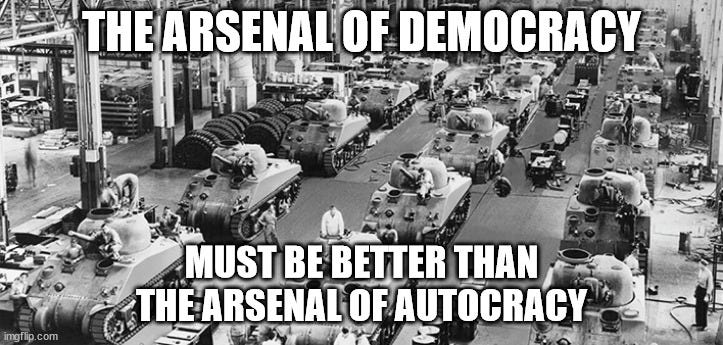
Soldiers will be ordered to fight with figurative pointy sticks if their original systems run out before the war ends. Let’s plan on giving our troops something good enough if not perfect in sufficient quantities before the first shots are fired. But don’t make our troops fight with long-war weapons when the mission is punitive or a battle. A model of 85% as good enough for peacetime conventional forces (Plan A), 100% as technology and budget allow for elite forces (Plan B), and 60% for mass production (Plan C) could match the broad needs of fighting for American national security.
This essay on the need to design weapons to be mass produced for a long war is spot on (tip to Commander Salamander). I’ve long asked if anybody sent off to war comes home by Christmas. But I’d like a little more distinction in weapons design.1
I’ve long believed that our high-tech weapons aren’t appropriate to sustain a long war:
I’ll note that in World War I, everyone thought the war would be over in months. But the war dragged on. Until factories and training camps could be geared up, old weapons and ammunition were used; weapons were fired less; and less-trained troops were sent into combat.
We have an additional problem of not having the ability to build new high tech weapons to replace losses.
So we’d have to build simpler weapons to supplement the really good stuff in a high-low mix.
Because face it, if a war isn’t won, it won’t end just because men and weapons are running out.
It’s like I was writing about the Winter War of 2022. Exquisite weapons (apparently “exquisite” is the term of art for expensive, complicated, and capable weapons these days) will be rare, I observed about them prior to Russia’s invasion of Ukraine:
Is the future of war hypersonic weapons, space warfare, and cyberattacks? Maybe for the first week until the fancy missiles run out and the enemy is thrown back to 20th- or 19th-century capabilities.
And as I wrote as the Winter War of 2022 entered its second year, I’ve long been concerned about Western inadequacy for sustaining a long war:
America isn’t the only Western country with the problem. And our problem is not the worst of the lot.
But the problem was predictable. And wasn’t fixed. And I did warn about this early in the Winter War of 2022.
We should be grateful that the West is having its noses rubbed into this mess while trying to sustain Ukraine in repelling the Russian invasion.
The issue is now generally appreciated and moving into actual action. This might be an avenue to keep fighting effectively:
Among the changes that Defense Secretary Pete Hegseth laid out in his Nov. 7 address to industry is the idea that the Pentagon will be more willing to buy a system that provides “the 85% solution” now and the full solution later. On Tuesday, a panel of industry executives talked at a Defense One event about what that might take and what it might mean.
“It starts with how much acquisition risk are [they] willing to take to decrease operational risk,” said Steve Harris, vice president of defense and intelligence at the Professional Services Council, a GovCon trade association. “It is a culture change for the department writ large, and eventually, I think probably the government, in terms of what the tolerance is going to be for acquisition risk, and that’s going to be something that has to be a major culture change.”
Hegseth said the extra testing and development needed to get to the 100% solution was often “unachievable.”
The contrast between the cheap and simple Flamingo cruise missile that Ukraine cobbled together versus the expensive and advanced Tomahawk cruise missile Ukraine wants is illuminating.2
Ukraine wants the Tomahawk. Which would expand their capabilities. But Ukraine has the cheap weapons like the FP-5 Flamingo to actually fight right now. I think every advanced American weapon and munition should have “monkey” versions that strip away the advanced technology to have things that can be mass produced. This would be critical should the unthinkable happen and our short and glorious victory with advanced weapons fail to unfold.
There is much talk of providing Tomahawk cruise missiles to Ukraine. But they are expensive. And we’d need ground launchers for Ukraine to use them. On the other hand, Ukraine found parts lying around in their garage to build the FP-5 long-range drone.
And this American ERAM development holds promise:
The Air Force recently held a live demonstration of an air-launched cruise missile that is being developed to give Ukraine additional long-range strike capability at low cost.
That could certainly help Ukraine.
If cheaper cruise missile drones can do the job in the mass needed, use them! If the added capabilities and expense of the Tomahawk allow them to carry out missions that the FP-5 or ERAm can’t reach, it would be good for Ukraine to have some of the expensive missiles, too.
But could the Tomahawk in more limited numbers do the entire job? Should the Tomahawk do the entire job if a cheaper weapon is available? This should be a procurement lesson for America.
Why not design a “monkey version” of the sophisticated Tomahawk—rather than an entirely new low-cost weapon—that can be produced in numbers after a war starts? Then we would have the mass to continue the war. Less effective missiles you can launch in the 10th month of the war are better than the best that are still trickling out of factories—so be patient while the enemy hits you with cheap mass!
Simplicity should certainly be the primary approach to aerial small drones:
Kipurs argued at the Drone Summit in Latvia, which Business Insider attended this past May, that “at times we overemphasize the sophistication of technology.” But Ukraine shows “that nothing’s more important than getting the job done, and sometimes the minimum viable product is what you should be focusing on in times like they have on the battlefield.”
Basic small suicide drones should be kept simple. But I would like modular attachments for when counter-measures make the simple drones unviable over the battlefield.
I firmly believe that small suicide drones are so successful in part because they entered a counter-measures vacuum. As passive defenses, active defenses, electronic warfare, tactics, and procedures fill that vacuum, the simple small drones will become far less effective if circumstances for their success aren’t achieved.
In that environment we will need more expensive and sophisticated (but far fewer) drones to overcome those counter-measures. I would like the simple basic drones suitable for mass use to be able to incorporate modules to add capabilities so that the drones can hit their targets.
And sometimes when the enemy is dislocated, you could go back to the simpler drones in large numbers. And as a war drags on, the need for simplicity will increase to supplement the more capable (and expensive) drones.
Indeed, expand this approach. I’d want all munitions and all weapons systems to have simpler “monkey” versions to replace losses. For mass production in a war that drags on, 85% as Hegseth raised, might be too high. Weapons development should design 60% for long war, 85% for deploying right now, and 100% for the future enhancements as technology matures that will be useful for high-value targets in great power war or in short, small battles where quality matters.3
Would we have wanted to bomb Iran’s nuclear facilities with B-52s? Penetrate Venezuelan defenses to arrest Maduro with standard grunt infantry weapons and basic aircraft and gadgets?
Such missions should have the best. But the best can’t be the enemy of the good in a broader campaign or war. Yet is that kind of 60% basic weapon design deliberately designing failure? This is highly relevant:
The idea that obsolete weapons still matter in modern militaries sounds counterintuitive, especially on the pages of the Modern War Institute. But the real question is not whether technology is obsolete and useless, but which category of obsolescence fits what role. ...
The hard truth is that our ability to predict future conflicts is limited and prematurely discarding conceptually obsolete weapons can backfire. Yet, in the face of budget cuts, such warnings are too often ignored.
Even if we stockpile old weapons just in case, that supply will eventually run out. Russia is experiencing that problem. Troops need something to fight with. Why not have war reserve 60% designs of our expensive peacetime stuff on the chance we do not get a short and glorious war as we intend and expect.
Hell, I bet Artificial Intelligence could be utilized to maximize the effectiveness of old weapons—or simpler weapons—by matching their reduced capabilities to the missions that don’t need to bounce the technology rubble.
Maybe armored vehicles, for example, should have less exquisite designs that look like the originals on the outside but which strip away everything but the basics in order to enable mass production.4 Less capable shooting, protection (crew compartment excepted), and mobility. Do this for everything else that is high tech, expensive, and which can’t be mass produced to replace losses. Is this the path the Pentagon is on with the new defense strategy?
The Pentagon calls for a “once-in-a-century revival” of industry by reshoring strategic industries and increasing capacity.
“We will therefore take urgent action to mobilize, renew and secure it—to supercharge American defense industry so that it is ready to meet the challenges of our era as effectively as it did those of the last century,” the strategy says.
Doing so requires growing nontraditional vendors while partnering with traditional vendors, Congress, allies and partners and other departments, the document says. ...
“This effort will require nothing short of a national mobilization—a call to industrial arms on par with similar revivals of the last century that ultimately powered our nation to victory in the world wars and the Cold War that followed,” the strategy says.
Non-traditional defense vendors could more easily shift to producing simpler weapons and systems.
And make sure they are easy to use for new crews. That’s important in a long war with losses in men ant materiel. RUSI notes that in the long war that Ukraine finds itself in, Ukrainian troops value ease of use and repair over more capabilities:
Ukrainians emphasise mobility, endurance and repairability as critical attributes for armour. In contrast, they generally perceive Western tanks as overly heavy and hard to repair. Crews may appreciate their survivability, but commanders find their availability diminishes quickly. Battle damage to armour is considered an inevitable consequence of its employment. As a result, the speed at which it can be recovered and repaired is critical to maintaining the tempo of operations.
That’s a problem with exquisite weapons. Surely, we have people who can calculate how to maximize usefulness and affordability for new production designs when losses exceed replacement production rates and when stockpiles of the good stuff is dwindling.
And working with American manufacturing companies on how to rapidly retool factories to make them.
I think of this approach as the difference between simple HE shells or rockets for area fire versus their more expensive precision versions to destroy specific targets with one shot. Both have their place on the battlefield. And as a war drags on and expands, the cheaper stuff is the only way to match the need for quantity.
A model of 85% as good enough, 100% as technology and budget allow, and 60% for mass production could match the broad needs of fighting for American national security.
You go to war with the weapons and munitions you have and not the stuff you wish you had—but having something in the hands of troops is the only way to fight.
And non-kinetic systems, too.
Assuming Flamingo works reasonably well.
These percentages are obviously just for illustrative purposes. I’m well out of my league to define how those percentages are even calculated let alone determining what values they should be.
You’d want them to look the same so simple visual detection doesn’t reveal which systems are simple and which are advanced.