

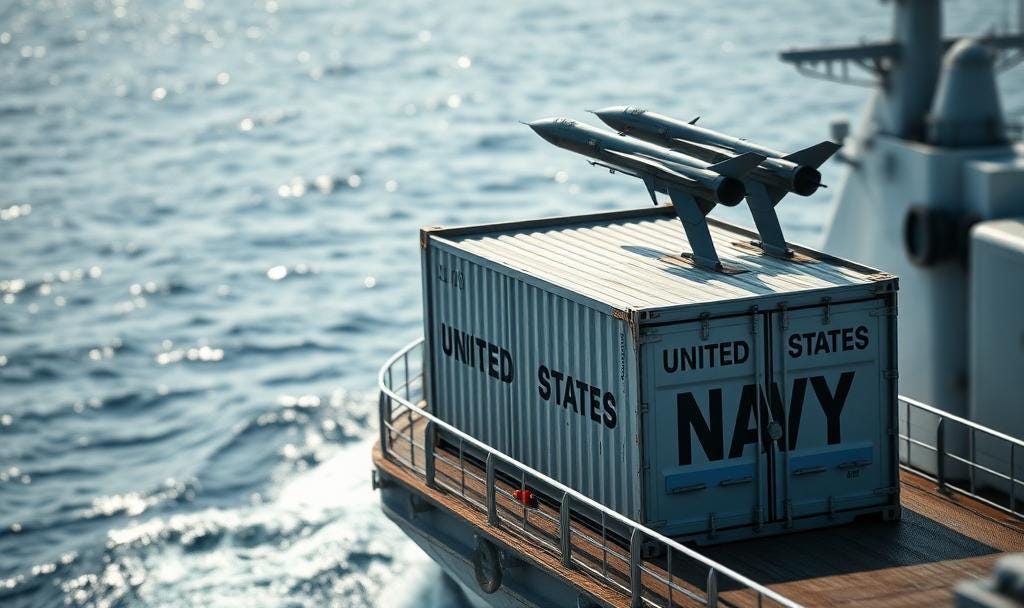
Could the United States Navy remotely operate missiles and systems in shipping containers rented to shipping companies to mount on their merchant ships and tankers going through the Red Sea?
When enemies have missiles, the anti-piracy solution of putting armed security guards on civilian shipping won't work. Rather than further arm civilian ships with better weapons, the Navy could take the lead in protecting shipping in the Red Sea:
A reason for the lack of an international solution might be simple. An international solution would require U.S. Navy leadership. The U.S. Navy would prefer aggressive Rules of Engagement (ROE). However, European navies might impose restrictive national caveats and ROE. The U.S. could risk conflicts with Iran. Additionally, U.S. actions might be seen as supporting Israel, which many wish to avoid.
But the Navy has global missions and a desire to focus on China's growing fleet. The equipment to enable my old Modularized Auxiliary Cruiser proposal could now be used to protect shipping.
Yet even those solutions might be too hull-centric for the threat. Why not put a thinner self defense system in several shipping containers with air defense weapons, Hellfires for small boats, and communications gear? These could be leased to civilian shipping companies to mount on a few of their civilian cargo ships and oil tankers. There is precedent—in at least a proposal because I don't remember this being carried out—although at a lower level of capabilities based on the then-lower threat level (quoting Strategypage):
A major British insurer (Jardine Lloyd Thompson) is organizing a private armed escort service for ships operating off Somalia. Called the Convoy Escort Programme (CEP), the 18 small patrol boats will offer armed escort through the Gulf of Aden, and reduce overall security and insurance costs for ships using the service. ...
The CEP is not a done deal yet. A country has to sign on to allow the patrol boats to fly their flag (and thus provide a national legal system to operate under). The patrol boats will carry heavy machine-guns (12.7mm/.50 cal), armed crews (all former military) and small boats to check suspected pirates.
Expanding that concept, the civilian merchant ships armed with remotely operating Navy defensive systems would sail with a linked American or allied warship equipped with the sensors to detect attacks, sailing with even more unequipped civilian ships in a convoy. The Navy warship crew—not the civilian crews—would remotely fire the weapons.
One could even have patrolling Navy or Air Force A-Whacks aircraft during the most dangerous legs of the trip.
Heck, United States CENTCOM could time offensive strikes with the convoy pulses going through Houthi firing envelopes. And sink or board any Iranian vessel providing targeting data for the Houthi, of course.
Let the shipping companies provide the hulls and the Navy provide the air defenses and trigger-pullers.
NOTE: I made the image with the Substack capability.