

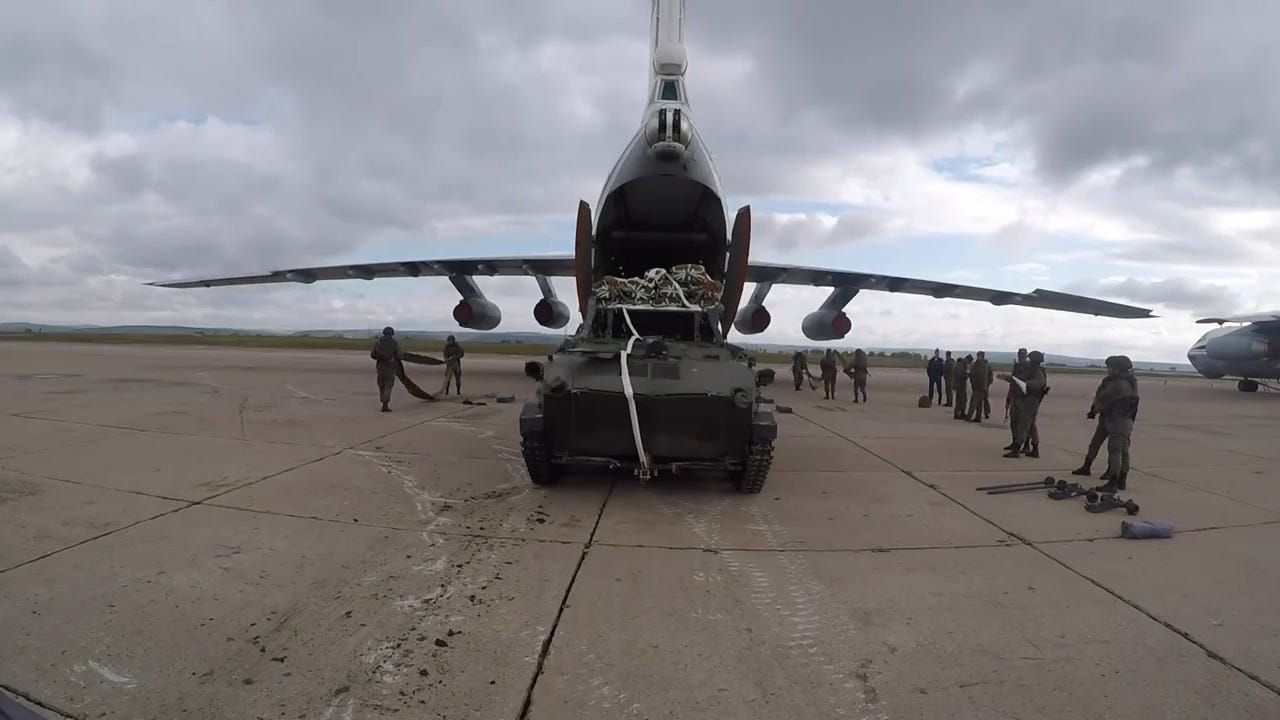
China needs means to cross the strait to invade Taiwan without relying on ships potentially vulnerable to counter-measures for the first wave of ground troops. China has contracted with Russia to get some of the increasingly rare technology (and training) that Russia has that surpasses China’s capabilities.
For now, Russia can still be squeezed by China for technology. And achieving the most core of China’s core interests will benefit from the latest transfer that RUSI describes:
Chinese President Xi Jinping has directed the People’s Liberation Army (PLA) to be ready to militarily seize Taiwan by 2027. A large-scale amphibious operation is highly risky, with the sites suitable for landing craft to deliver troops and equipment ashore constrained by the gradient and load bearing capacity of the beaches. Seizing airfields could allow troops to flow in by air, but as Russia discovered during its invasion of Ukraine, runways can be quickly denied. The PLA is therefore eager to identify ways of diversifying both the methods and locations at which it can move units onto Taiwan.
Although the areas where Russia surpasses China in military capability are diminishing, Russia has practical experience and capabilities for air manoeuvre that China lacks. According to contracts and correspondence obtained by the Black Moon hacktivist group, Russia agreed in 2023 to supply the PLA with a complete set of weapons and equipment to equip an airborne battalion, as well as other special equipment necessary for airborne infiltration of special forces, along with a full cycle of training for operators and technical personnel to use this equipment. In addition, Russia is transferring technologies that will allow China to scale-up the production of similar weapons and military equipment through localization and modernization.
The actual invasion will have started before the shooting starts. Special forces and intelligence officers will infiltrate Taiwan, placing navigation aids to guide parachutists and missiles, and preparing for direct attacks on Taiwanese strategic assets. They might even stock warehouses with consumable supplies and vehicles to be used by the invaders.
Civilian merchant ships on scheduled arrivals will be loaded with supplies, weapons, and light infantry battalions and will sail into Taiwanese ports on both coasts. …Warships, amphibious warfare, and drafted commercial ships loaded with troops put to sea and aircraft take off.
For the first impact, Chinese special forces and intelligence operatives hit radar stations, assassinate leaders, sabotage crucial bridges and tunnels, hit Patriot missile sites and communication centers, anti-ship missile batteries, ammunition depots, and strike at air fields.
The light infantry on the merchant ships in Taiwanese harbors will unload and attempt to seize the ports on the west coast or, on the east coast, sabotage facilities and otherwise prevent the Americans and Japanese from using them to reinforce the Taiwanese. Their very presence will deter or at least delay reinforcements. …The Chinese will drop their parachute divisions near Taipei to go right for the jugular by seizing the center of government. (I’ve read the Chinese can lift 22,000 in one day so this should be possible.) With an airfield secured, the Chinese will airlift their urban cavalry division to march on the capital itself. The parachute units will try to cordon off the capital to keep reinforcements from coming in to the rescue.
[Let me link to a later post showing that an amphibious assault can aim for Taipei, too.]
I don’t know if the Chinese still have what was called an “urban cavalry division” but the RUSI article notes that China maintains air transportable forces. So the capability if not the name remains.
Also, in the two decades since I wrote that description, PLA light infantry secretly sailed into Taiwan’s ports could bring along shipping containers filled with short-range FPV suicide drones, cruise missiles, and even air defense weapons to add to their punch.
Follow up forces will exploit the foothold and chaos that the wide variety of air, cyber, and ground troop attacks on Taiwan achieve to lessen whatever anti-ship effort can be mounted against China’s invasion fleet. I’m skeptical of Taiwan relying on suicide unmanned surface vessels of the type Ukraine has used. But there will be an effort with guided anti-ship weapons from the air, ground, and sea—both on the surface and underwater.
And it doesn’t matter that China lacks a large fleet of amphibious warfare capabilities to replicate the D-Day invasion:
As I’ve long argued, even America doesn’t have the amphibious capability to throw anything close to hundreds of thousands of troops across beaches. China’s capability is weaker and mostly a red herring. So it is misleading to track Chinese amphibious warfare vessels as a metric for invasion capability.
I used the German invasion of Norway as the template for a PLA invasion of Taiwan scenario:
This is the basic problem. You are a major land power with plenty of troops and aircraft and you wish to conquer a far smaller country. While the status quo is acceptable, a change for the worse is not. The problem is you have to cross quite a bit of sea to get to the target and you have little amphibious warfare capability. To add to your misery, a major power with a powerful navy that includes aircraft carriers, possibly supported by another major power, may intervene to stop you.
This is China’s problem today. They may need to invade Taiwan but the United States and maybe Japan stand in the way. But it was also Germany’s problem in the spring of 1940. As long as Norway was neutral, Germany could import critical iron ore and remain free from attack from enemy bases in Norway. Germany had to contemplate British and French resistance to their plans or even preemptive action. Yet Germany pulled off the invasion and Norway remained under German control for the remainder of the war.
China is in a much better position than Nazi Germany with both naval power and air power by being just 100 miles across the strait from Taiwan. And the mainland is basically a giant amphibious warfare ship:
China’s marines are a red herring. Scrutinizing them for clues about China’s intentions and capabilities for taking over Taiwan is counterproductive.
Over the last 20 years China has invested in building up a massive force of modern military helicopters. Chinese sources explicitly state such forces “were largely designed around cross-sea flight operations” – namely for the Taiwan scenario.
China itself is a giant amphibious platform 100 miles away from Taiwan:
If you have a giant amphibious platform 100 miles away (China itself), you have options other than big deck amphibious ships to move your helicopters close to the target, eh?
Why would China need a fleet of big deck amphibious ships to move your helicopters close to the target? China is already close to the core objective of China’s current foreign policy.
So don’t you dare object by saying China lacks America’s kind of dedicated amphibious warfare ships and Marine Corps on a scale needed to invade.
And Russia understands the problems of air assault given its defeat at Hostomel airport during the initial invasion of Ukraine in 2022.
Air assault can’t be the entire invasion, of course, even when expanded. But it is a force multiplier (back to the RUSI piece):
The capacity to airdrop armour vehicles, therefore, on golf courses, or other areas of open and firm ground near Taiwan’s ports and airfields, would allow air assault troops to significantly increase their combat power and threaten seizure of these facilities to clear a path for the landing of follow-on forces.
That stretches out Taiwan’s small army and air defenses even more.
China even has its eye on targets inside Taipei:
China has expanded a military training mock-up of government buildings in Taipei, including the Presidential Office Building, by almost threefold since 2020, according to satellite images of a training base in Inner Mongolia obtained by think tank Japanese Institute for National Fundamentals, the Sankei Shimbun reported yesterday.
I don’t know if this is primarily for aiding targeting by visual cues or for ground troop training. But both help China get good enough to win.
Add more aerial invasion capabilities that kick in the door to all the other capabilities to cross the Taiwan Strait that China has and is developing, and you can have a sizable bridgehead:
Taking Taiwan (the Republic of China) has long been the most core of China’s (the People’s Republic of China, or PRC) core interests. Yet after decades of China’s massive military modernization, China doesn’t have the means to invade Taiwan? I think a little here and a little there, and pretty soon you are talking real troop numbers landing on Taiwan.
And the capabilities could be used to jump on islands around Taiwan to block allied efforts to rescue Taiwan.
If China attacks Taiwan, they could go for the jugular. And even if that lunge fails, the invasion could succeed just by maintaining a PLA bridgehead on Taiwan, as I wrote about in Military Review.
NOTE: Image from militaryleak.com