

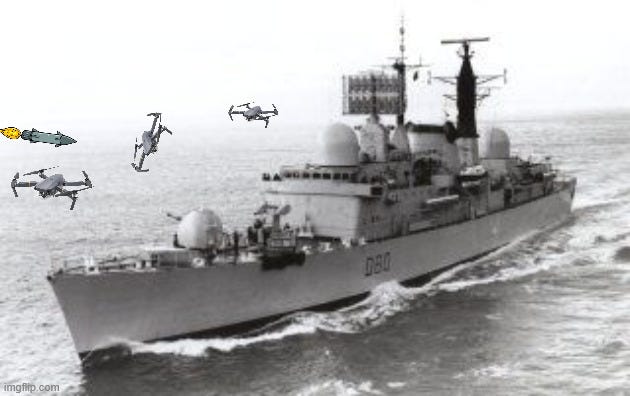
During the Falklands War, I read that British helicopters were assigned the mission of protecting valuable surface ships from Argentinian Exocet anti-ship missiles by being aloft during an attack so they could physically place the helicopter in the missile path to detonate the missile and save the ship. Why couldn’t unmanned aerial vehicles (UAVs) do that?
The Battle for the Falklands by Max Hastings and Simon Jenkins (p. 157) noted a scary helicopter mission in the Falklands War after noting the shock of losing HMS Sheffield to a cheap Exocet missile and the British sought ways to cope with the threat:
... helicopters could fly far more frequent missile-decoy missions around their parent, carriers, frigates, destroyers.
Note, too, that another response to the loss of a single warship—admittedly a loss that showed general vulnerability—was to keep the task force aircraft carriers farther away from Argentinian assets.
Some time ago I wondered if massed UAVs could be used for defending against incoming ballistic missiles? That notion was on my mind for a while:
Could a swarm of drones with explosive reactive armor mounted on top of the drones be used to stop incoming ICBMs?
The drones would fly into the path of an ICBM and hover there in a tight formation to let the ICBM strike one or more of the drones, setting off the ERA panel to wreck the warhead.
I guess the factors for success would include how fast UAVs in a formation could get to the right altitude. And what would it take as far as drone size or capabilities to break up an incoming warhead or disable it.
But even if that use is possible, I think we could use the concept in a more immediately practical form—ship defense further out than a last ditch Close-in Weapons System (CIWS). Perhaps a USV slaved to a traditional ship could sail between the crewed primary ship and known enemy anti-ship threats rather than jam more systems on the primary ship.
This would be a fast, fleet version of my modularized auxiliary cruiser for defending choke points in sea lines of communication.
If a piloted helicopter could be ordered to convince missiles to stop heading for the ship, small drones could do that, too. Putting a small drone in the path of the missile is a lot better than losing a pilot and expensive helicopter.
Still, keep the shooting CIWS turned on in case the drone screen fails.
NOTE: Sheffield with drones and a missile that I added in imgflip.com