

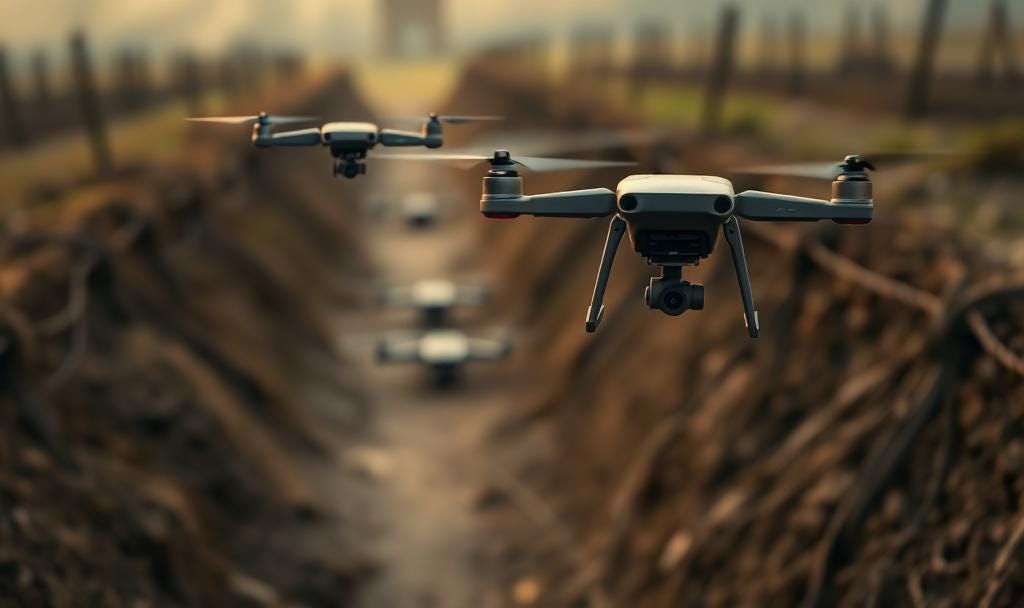
I believe the small air and (potentially) ground drones playing such a huge role in Ukraine are a means of coping with stalemate rather than the cause of the stalemate.
Hard to argue with this observation about the Winter War of 2022:
Drones are now so dominant that they force everything else—infantry, armor, artillery, logistics and even trench design—to adapt to a sky full of buzzing robots.
But interpreting the significance of those aerial drones in the stalemate is another matter.
Yes, yes, the front moves like lava flows—as the article says and as I've observed—and there is much happening along the battle lines. Static doesn’t mean inert. So don't rely too much on a definition of "stalemate" that insists on no movement, combatant passivity, and no chance of that changing. We have no problem calling the Western Front of World War I a stalemate from 1914-1917. There was movement and activity then. In Ukraine we see the details with color drone footage and constant updates. Which is a stalemate without the fog of time to obscure that reality.
During the first two years of the full-scale war in Ukraine, Ukrainian forces inflicted devastating defeats on Russian forces using massed artillery, anti-tank guided missiles (ATGMs) and well-motivated infantry. The switch to ever-greater reliance on UAS has been driven as much by necessity as by any desire to directly replace such conventional capabilities.
Ukrainians understand that in many cases more traditional weapons would be superior if they could get them in sufficient numbers.
Further, drones can be spun up and slowly make their way to the target area because the intermittently and slowly moving front provides time to do so:
When the frontlines are largely static, the slower response time and lower reliability of FPVs against hardened targets compared to BONUS rounds and ATGMs doesn’t matter nearly so much, and their far greater availability allows them to be expended more sustainably.
Consider Ukraine’s mid-August counter-attack at Russia’s deep penetration in the east:
There may have been thousands of Russian troops in the nine-mile salient, but they lacked drones[.]
Being just a little beyond the reach of sufficient FPV drone coverage that dominates the expanded No-Man’s Land along the front left the Russian spearheads vulnerable to the Ukrainian troops rushed to deal with the Russian presence threatening to isolate Pokrovsk or even unhinge Ukraine’s defensive line in the Donbas.
The Russians outran their drone support because the drone units are moveable but not really mobile:
Most of the drones are flown by operators ten or more kilometers away in bunkers. If these bunkers are attacked by Russian drones, the inhabitants close the blast resistant door and wait for the attack to end.
This static, frontline-adjacent means of operating describes Ukraine’s drone force but surely is very close to what the Russians do.
Early on, I recognized that small aerial drones exploited rather than created stalemate:
I suspect that the static front magnifies the effect of the small strike drones:
Just as snipers had an outsized role in the World War I trenches, surely it is easier to use the cheap drones when the operators have a secure area and operate over familiar territory--because the front isn't moving much--with those short-range suicide drones.
I imagine the same is true for recon drones. Recon drone information is siloed and the information gained will often take time to get stale. Unless the information from many drones is fused and analyzed in minutes, this capability is also a static-war feature.
If war goes mobile, how do the short-range small drones operate when patient searching is needed? How do they identify targets that are moving--and perhaps heading for the drone operator's position with fire support raining down suppressing and killing fire? How do you use drone information to mass fires from many sources--some far away--to break up fast-moving, large formations.
We won't even speak of the hype over sea drones. I believe that the intelligence, surveillance, and reconnaissance (ISR) assets that NATO made available to Ukraine were the key to Ukraine's success in the Black Sea.
Similarly, the ISR network from NATO-provided aircraft and satellite information to Ukrainian drones roaming over the land battlefield in large numbers has been more important for enabling all firepower and not just the suicide FPV drone-provided firepower.
Land drones are the latest to get the FUTURE OF WARFARE treatment. And robotic ground systems are being added to Ukrainians units along the front, trying to make up for the shortage of infantry and cope with Russian aerial drones:
Ukraine is equipping their combat brigades with ground-based combat and transport robots in addition to drones. The ground robots come in different versions. Some are used for planting and removing landmines. Other drones advance along the ground while firing remotely controlled machine guns. These systems can fire accurately at moving targets during the day and at night. There are also drones for transporting supplies to the front lines and carrying casualties back to first aid stations and field hospitals.
Yet I'm not impressed by these small ground drones. So far they are better tools for trench raids and not tools to break a stalemate. And engineering obstacles would stop those small toys cold for the trench raids. Ultimately, land drones need a minimum size—I'm not sure what that is—to be true armored combat vehicles fit for mobile warfare. And that will make them expensive even without crew to protect. This Russian unmanned model is a tank and not a cheap UGV replacement for manned tanks to get expendable numbers.
The ground drones are absolutely useful in the war Ukraine is waging right now. In limited roles and numbers. But they would not be nearly as useful in a war of movement. That capability will take time to design and integrate broadly into combined arms level well above what we see in Winter War of 2022 usage thus far.
Just don't treat the ground drones—when they arrive—as silver bullet solutions to battlefield problems.
NOTE: I made the image with the Substack capability.