

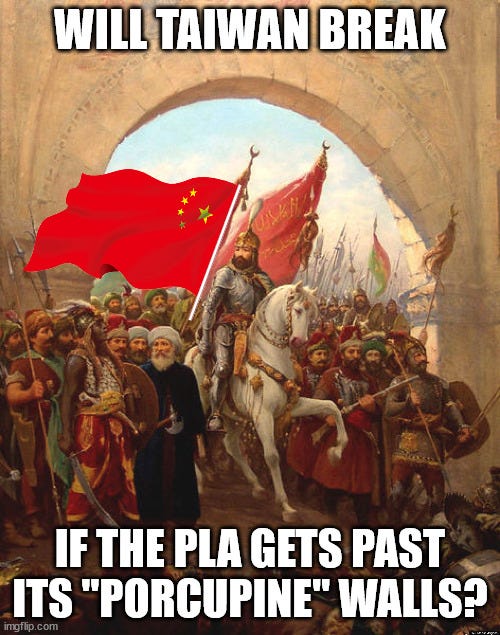
Taiwan must be able to defeat China's People's Liberation Army (PLA) to preserve its island democracy. Trying to calculate how much pain China must endure to discourage its rulers from invading is folly. Ancient Athens demonstrated the need to defeat the enemy on the beaches rather than give them time and opportunity to undermine Taiwan's resolve to win.
I keep hearing how Taiwan can make China pay too high a price to conquer Taiwan by building a "porcupine" defense that destroys and kills a lot of China's invasion force. And if the PLA gets ashore, urban combat will to too daunting for China to conquer Taiwan. And if the PLA takes the major cities, Taiwanese can fall back to the mountains and deny China the ability to control Taiwan. All of this will deter the Chinese Communist Party (CCP) from ordering the PLA to invade and capture Taiwan.
I say that view of calculating the CCP’s pain level is hogwash:
Too often, analysts who speak of deterring a potential enemy assume that deterrence-level forces can be deployed to maintain peace. This is supposed to be less expensive than building military forces capable of winning a war. That kind of nuanced defense thinking is folly. It invites war.
And God help us, but sliding down from military superiority to military deterrence leads to even more BS levels of deterrence strategy.
I suspect that all the deterrence calculations could get tossed into the air because China may find enough Taiwanese eager to undermine resistance from the Taiwan Strait to the mountains. A number of Taiwanese believe it is better to be Red than dead:
Over the past few months, a grassroots movement has swept through Taiwan, aiming to remove dozens of lawmakers from a political party seen as selling out the nation’s interests to Beijing. Ultimately, two-thirds of the targeted politicians survived a recall vote on July 26, an outcome that the movement’s leaders and analysts say only underscores the depth of CCP infiltration.
The legislators are members of the opposition Kuomintang Party (KMT), known today for its pro-Beijing leaning. Leading a slim majority in the legislature, the party provoked backlash after a series of unpopular moves: slashing Taiwan’s defense budget, striking down bills that aimed to counter threats from China, and forcing through changes to expand the party’s legislative power despite mass protests. When the power grab failed in court, the KMT-led coalition imposed a procedural rule that effectively paralyzed the Constitutional Court of Taiwan.
I've relied on the precedent of the fall of Constantinople for doubting Taiwan's will to resist the invasion when the going gets tough. But the basic problem and solution can be found in tiny Athens on the eve of the vast Persian Empire's first invasion attempt.
Athenians were divided over the city-state’s conflict with the vast Persian Empire on the other side of the Aegean Sea, as my always-handy Encyclopedia of Military History describes the situation surrounding the 490 B.C. Battle of Marathon pp. 23-25):
About the same time [as finding out the main source of support for Athens, Sparta’s army, wouldn’t arrive for nearly two weeks] word reached Athens that the Persians were landing near Marathon, some 26 miles away. The Athenians, about 9,000 hoplites and a smaller number of light troops, immediately marched to high ground overlooking the Persian debarkation. Here they could block the route leading from the narrow coatal plain toward Athens. They were soon joined by a small force from Plataea.
But blocking the Persians wasn’t enough:
The Persians apparently knew that many Athenians, fearing defeat and the destruction of their city, were ready to surrender. They had landed at Marathon for the express purpose of drawing the Athenian troops away from the city. Having accomplished this, Artaphernes embarked with half of the Persian Army, to sail around Attica for Athens, while Datis and the remainder (possibly 20,000 men) stayed ashore to hold the Athenian Army immobilized at Marathon.
The Athenians figured out what the Persians were doing and decided to attack rather than return to Athens with a Persian army pursuing them back to a city that may already have revolted and opened the gates to the seaborne Persian expedition heading for the city.
The Athenians attacked with a thin center and full-depth hoplite elements on both flanks, resulting in the Persians repulsing the center force while the flanks drove back the Persians and then wheeled inward for a double envelopment of the Persian line to destroy much of the army and drive the rest back to the shore. Those troops were able to board ships and escape—possibly because a Persian rear guard held off the Athenians sufficiently.
But the weak home front was still vulnerable:
Miltiades now promptly set his tired but jubilant men marching back toward Athens. In advance, in hopes that tidings of the victory would strengthen the wavering citizens sufficiently for them to hold out until the army arrived, he sent word back by a runner, reputedly Pheidippedes, on the first Marathon run. As the Athenian army arrived, the Persian fleet was only beginning to approach the shore for a landing. Realizing he was too late, Artaphernes withdrew.
The Spartan army arrived that evening, “chagrined” to be too late for the battle.
Too often, victory for Taiwan is defined as preventing the PLA from capturing Taipei, the capital, within a certain time limit—such as the brief time a simulation can be played by busy people. And while the focus is on stopping D-Day-style PLA beach landings, I fear the PLA invasion will supplement multiple ways of crossing the Taiwan Strait with a direct attack on Taipei:
The Chinese will drop their parachute divisions near Taipei to go right for the jugular by seizing the center of government. (I've read the Chinese can lift 22,000 in one day so this should be possible.) With an airfield secured, the Chinese will airlift their urban cavalry division to march on the capital itself. The parachute units will try to cordon off the capital to keep reinforcements from coming in to the rescue.
As an aside, I don’t know if that old reference to an urban cavalry division is still good. But if not I assume other forces could be airlifted or otherwised moved in.
But containing the Chinese in their coastal bridgheads if one of the PLA’s attack vectors goes right for the jugular while the Taiwanese army is immobilized at the shores risks total capitulation to China if too many Taiwanese refuse to fight for the capital city because they believe it is suicidal and futile to fight the vast host landing from across the water.
There are Taiwanese who dream of a united China under CCP rule if Taiwan can’t somehow stage a new Northern Expedition against the colossus on the mainland and be those rulers of one China. To prevent giving those wavering people the opportunity to realize that ambition, Taiwan must drive the invaders into the sea, as I wrote about in Military Review. Anything less simply gives pro-mainland people opportunities to betray free Taiwan, either in the initial invasion or in a subsequent operation.
And if word arrives in Taipei that the PLA is being ejected from Taiwan, the battle for Taipei may be every bit as hard for China as the calculations claim.
But apart from narrow formulas for specific fights, don’t believe the China-Taiwan conflict is purely a mechanistic military capability calculation undisturbed by deep passions about what is ultimately best for Taiwan.