

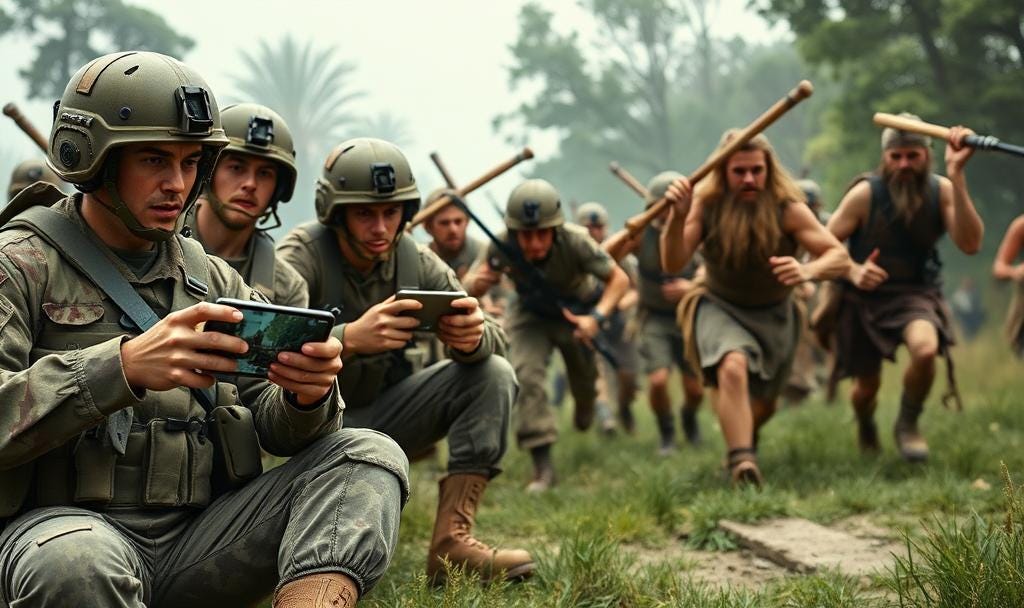
If our infantry isn’t in the business of closing with and destroying the enemy, what part of the Army will do that? I worry that in the rush to get small drones into the hands of Army infantry that the infantry will become drone operators rather than better infantry.
I’ve mentioned this infantry weapon:
At Grafenwoehr Training Area in Germany, the Joint Multinational Training Group–Ukraine (JMTG-U) Unmanned Aerial Vehicle innovation team carried out an unusual and closely watched live-fire event. Between September 9 and 12, 2025, soldiers tested a purpose-built aerial dropper system by releasing 117 live M67 fragmentation grenades from a Skydio X10 Delta drone. The evaluation, supported by the U.S. Army Combat Capabilities Development Command (DEVCOM), represents the latest effort to integrate precision-guided firepower into the smallest tactical formations.
A culture shift around sUAS across all combat units means embedding drone experimentation into training cycles, building local sustainment and fabrication capacity, and treating drone teams as integral parts of tactical formations. Such a shift will not happen by directive alone. It will require resourcing the lowest levels, tolerating failure, and decentralizing innovation authority. It must begin with the squad leader and the drone in his or her rucksack.
To prepare for the next war, the US Army must stop waiting for perfect answers from the top and start empowering its youngest, most adaptable warfighters to build, experiment with, and break equipment like sUAS, reimagining the battlefield from the ground up. This does not mean abandoning oversight, doctrine, or security. It means recognizing that in a world of massed, networked, and expendable sUAS, the only way to stay ahead is to innovate faster than your adversary. That innovation will not come from a program office. It will come from the mud, the barracks, the garage, and the field. If we are serious about competing with peer adversaries, then it is time to let the squad fail—early, often, and forward.
Precision firepower continues to get cheaper. Once expensive and only deliverable by specialized aircraft, precision firepower is reaching individual troops. This will speed battle tempo tremendously. ...
We already have plenty of precision air power and tube and rocket precision at brigade and higher levels.
Add in drone/grenades or mortar rounds (as a mini-air force for both strike and surveillance capabilities, and communications), precision 60mm mortar rounds at the platoon level, guided 81mm mortar rounds at the company level, and precision 120mm mortars at the battalion level, and we speed up the tempo of conventional operations tremendously by reducing the need to call up the chain of command for needed support, when coupled with Blue Force Tracker technology that lets our commanders see where their troops are.
Indirect firepower down to the platoon level in a weapons squad. But when you talk about small drones in squads, I have to ask if we are turning infantry into little air force units:
We need somebody to close with and destroy the enemy, don’t we?
This is why years ago in Army magazine I called for fighter drones to protect forward units because if those units have to protect themselves from drone attack, they are distracted with their primary missions of closing with and destroying the enemy.
But now even infantry squads could gave small drones for precision bombardment?
Why? When precision to support the squad is at the platoon, company, battalion, brigade, and higher echelons already? And with a Black Box of Effects, within easy reach?
I’m not against letting infantry experiment with small drones. But I want the parameters of that experimentation to include learning how to use small drones to improve the infantry’s ability to close with and destroy the enemy.
Because if the infantry doesn’t do that, who will?
People are really trying to undermine my contention that despite new technology, the Army will always need trigger pullers.
NOTE: I made the image with the Substack capability.