

We don't need warriors, but we do need soldiers. Technology won't change that any more than past technological advances that required turning more of our soldiers into technicians-in-uniform rather than front line soldiers. At the shrinking point of the lengthening spear, duty, honor, country, freedom isn't just a slogan, it's the first part of a chain of events.
Technology and AI don't make soldiers obsolete:
We’re at a moment of convergence. Three crises, plummeting enlistment, outdated training regimes, and the rapid rise of military artificial intelligence, are forcing a sweeping reassessment of what the Army is, what it needs to be, and who (or what) actually fights wars in the 21st century. ...
The future soldier may carry a keyboard instead of a rifle or fly a drone from halfway across the globe. That doesn’t make them any less vital. But it does mean we must rethink how we train, who we recruit, and what mission readiness means in an AI-era battlefield.
After all, the Army’s greatest asset is still its people. But those people and their roles are changing quickly, and we must change with them.
True direct combat soldiers (not to be confused with warriors)—who carry out their duty to fight and win even when it is up close and personal and the situation is desperate—will always be needed.
Recall the defenders of Constantinople—competent technicians manning the superb technologically advanced weapons and walls—who collapsed when a tiny penetration of those defenses was made. Soldiers were needed up close and personal to save the day, but there were none:
A small group of about ten knights and sixty sergeants led by Peter of Amiens landed on a narrow strip of ground outside the wall and near the shore. There they discovered a postern gate that the defenders had walled up. They fell upon it zealously with whatever implements they had on hand. It was hard going and dangerous, for from above the Greeks rained down on them immense stones and boiling pitch, which they deflected with their shields. At last, they succeeded in making a small hole. Peering through, they saw a huge crowd of soldiers inside. Surely, it was suicide to enter. One man, an armed priest named Alleumes of Clari, insisted on the honor of being the first to enter Constantinople. No amount of pleading from his comrades would dissuade him. His brother, Robert of Clari, was particularly upset and even tried to prevent him from crawling through the hole by grabbing his legs. It was no use. Alleumes scrambled through to the other side, where he was faced with an armed multitude.
Then an amazing thing happened. With enormous confidence, Alleumes drew his sword and ran toward the Greek troops. They scattered. Once again, the poorly trained Byzantine troops proved themselves unwilling to fight unless the dangers to themselves was minuscule. Because most of them were provincials, they saw no reasons to risk their lives for the sake of the capital. Alleumes called to his companion, who now crawled through the hole, drew their swords, and kept their backs to the wall. When Greek troops at other locations saw the flight of those stationed near the walled gate, they panicked and abandoned their positions along the walls. Soon there was a snowball effect as the imperial army abandoned the length of the fortification in a mad dash to escape the city--all because of the entry of fewer than a hundred crusaders.
The number of soldiers on the battlefield will go down, as battlefield density trends have long shown since the introduction of gunpowder weapons:
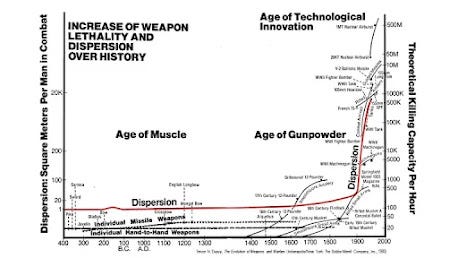
So further reductions in actual soldiers on the battlefield as technology requires more dispersal with effort massed with superior coordination is natural. AI to keep track of dispersed soldiers and support is just one more advance that soldiers must adapt to. But soldiers will still be the tip of the spear that wins with the vital support of the technicians.
I took a stab at adapting training to account for one new technology—which I called dumb-but-controlled (DBC) assisted-aim rifles in this USNI blog post:
Marine boot camp must shift the focus from training every Marine to be a rifleman to teaching every Marine by virtue of their rifle a marksman how to maximize that technology on the battlefield. Marines must be taught early how to move and position themselves, to avoid being targeted, and to find enemies first to shoot first in order to counter DBC-equipped enemies who can shoot as accurately as Marines with similar equipment.
Examples of revisions to initial training at the expense of marksmanship include:
Tactical prowess in finding and using cover and concealment.
Choosing and constructing superior fighting positions whether on defense or when advancing.
Fire suppression that is proactive and not reliant on the enemy missing their first shots to allow reactive fire suppression. But reconnaissance by fire that could panic less trained troops to open fire from cover or concealment will not work as well against troops whose rifles won’t allow them to fire until they are aimed and are likely to hit their targets.
Moving beyond simple fire and movement skills that teach short dashes to cover while a buddy provides overwatch must be pushed down to boot camp. Superior maneuvering skills to prevent poor quality but super shooter enemies from counting on a frontal assault will break enemy morale. Even super shooters running away can’t hit their targets.
A thorough exploration of what Marine boot camp should include when marksmanship training no longer dominates must be carried out to keep the Marine training advantage.
The observations apply to the Army, too, of course.
Technology to enhance the advantage of trained soldiers must be pushed down to the troops who shoot, I wrote:
In addition to adopting the new shooting technology and improving it for Marines, such as the DARPA self-steering round that would be superior to DBC rifles, the reaction to enemy shooting technology of necessity must include other new technology to cope.
Some aspects to consider for coping technology include:
Better body armor. But if DBC and guided rounds prove effective in delivering single shot accuracy, the firearm of choice for enemies may evolve away from small caliber automatic fire that allowed spray and pray to single shot large rounds able to punch through armor or to stun with even non-penetrating impact. What beyond passive body armor will counter that?
Means of reducing enemy concealment through better sensors even if enemy cover can’t be affected will tip the balance back. Armed aerial, ground, and subsurface intelligence, surveillance, and reconnaissance (ISR) drones will need to blanket a battlefield to provide data to individual Marines.
Fusing incoming ISR data into actionable views of the battlefield at the level of the individual Marine is needed for superior situational awareness to enable superior maneuver and to enable information-driven fire suppression.
Cheap disposable sensors that can be fired ahead of troops could replace recon by fire to provide timely ISR capability at the squad level.
Mobile smart mines could “take point” ahead of Marines to seek out armed enemies and either initiate kinetic suppression with reliable programmed rules of engagement; or remotely by actual Marines interpreting what the mobile smart mines discover.
Camouflage that alters or suppresses the signature of Marines designed to confuse the sensors of DBC rifles or of guided rounds to prevent being targeted rather than concealing Marines from being seen by enemy fighters may prove superior.
Means of preventing an enemy from shooting first, surviving being hit, and reducing the number of Marines exposed to enemy fire should be explored to cope with enemy DBC rifles or guided rounds. The Marine Corps is committed to experimentation to identify technology useful for future battlefields.
I haven’t read this since I wrote it, but I must say I think lessons from Ukraine would include them if expressed more broadly than my specific infantry focus.
So yeah, the Army must change. Many roles in the Army must change. But soldiers will always be needed. And how soldiers fight will change even as how they die—alone and crying for their mother in their last breaths—will not.
Surely, I can't be the only one who marched in training with something like the cadence "Please President Reagan, send me to Iran, to kill for my country, to die for my land"; "Gory, gory, what a Hell of a way to die"; and "Tell my mom I done my best. Bury me in the leaning rest".
All your training on battlefield first aid should have been a clue, too, no?
The need for actual soldiers willing to win under those conditions at the price of their lives if necessary—even if you call them marines, sailors, airmen, or guardians—will not.
Not that I'm claiming to be more than a reservist REMF, mind you. But I was never confused about my role as a technician, vital as that role was. I was not a trigger puller. I was one small part of the force that enabled the trigger pullers to fight, survive, and win. I can hope that if my unit had come under direct attack that I would have been part of whatever fraction of the company that resisted. But I can't really know. But I do know I'd want trained and committed trigger puller soldiers doing the protecting instead.
Pray we always raise such young men willing to enlist and do their duty; and have the wisdom to train and equip them to fight for our country if necessary to preserve our freedom.
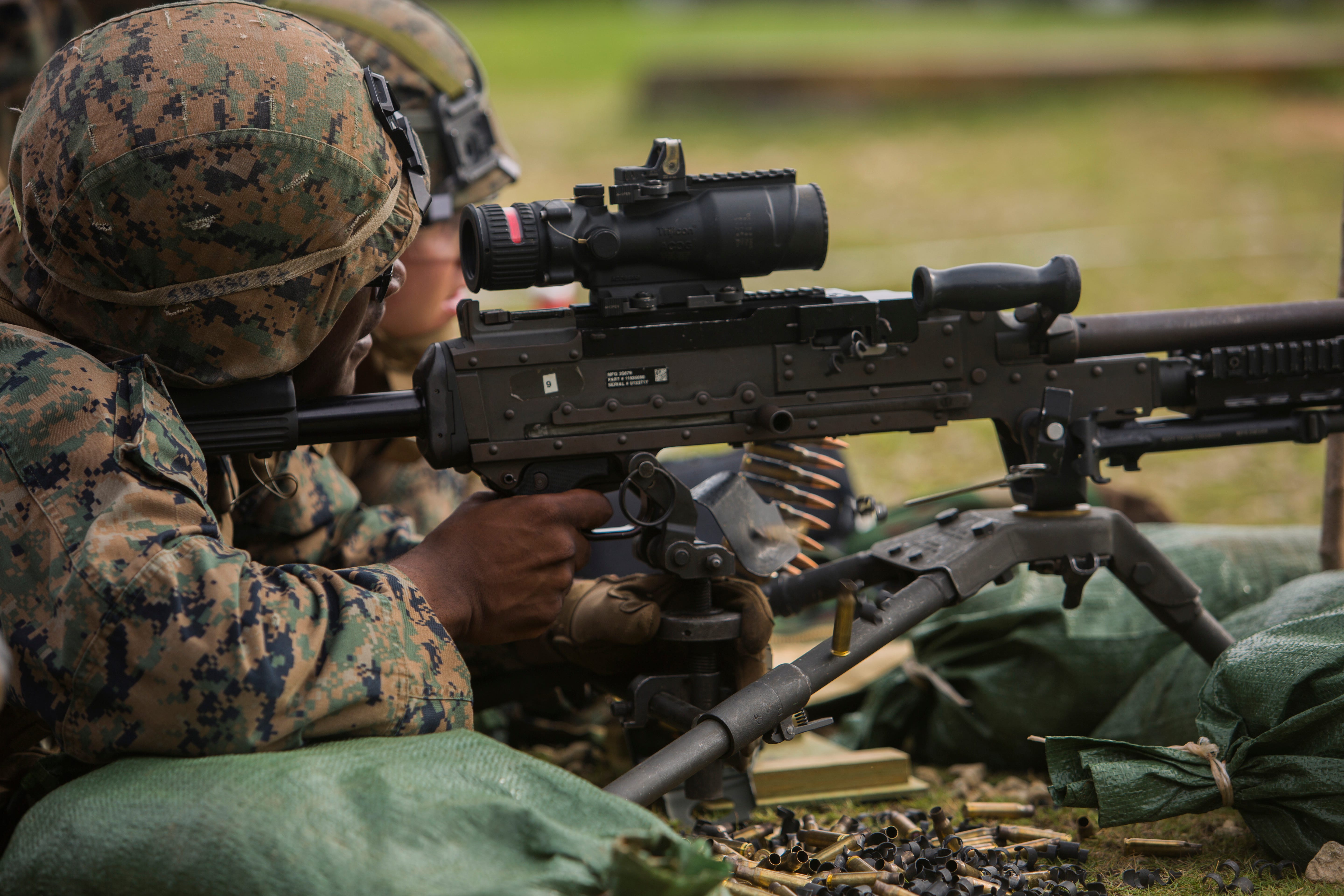
NOTE: Photo from the USNI blog post I wrote.