

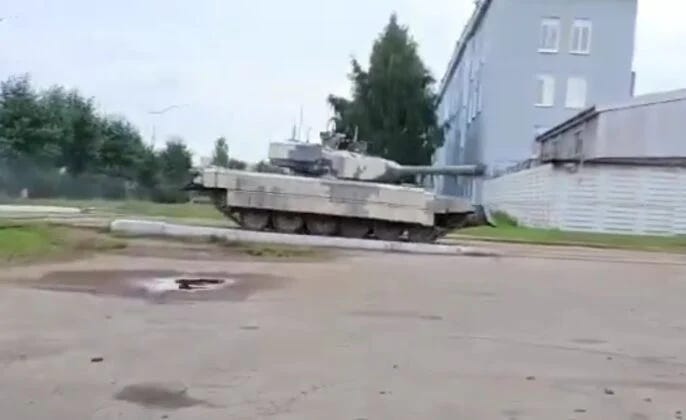
Russia has modified a T-72 to be an urban assault vehicle drone. It is big enough to maneuver but too expensive to be a successful drone. This is a dilemma for conventional combat operations that unmanned ground vehicles (UGVs) need to solve to be more than an evolution of current expensive armored combat vehicles.
UGVs seemingly allow us to make first contact without losing our own troops. That is good, but it does not do anything about the problem of cheap enemy aerial drones taking out expensive tanks and other armored vehicles and equipment.
Any large main battle UGV will certainly be able to save lives with no crew. And it will lower protection needs somewhat with no crew. So that saves money. But going without crew will add expense. And will we really not spend more to protect that high-value UGV even if no humans are at risk? I don’t see how UGVs solve the problem of coping with cheap suicide FPV drones at the vehicle level of solutions.
We’re getting our first full look at Russia’s ‘Shturm’ robotic tank complex.
The new combat system was first identified during recent field trials, where it appeared for the first time in its complete configuration—featuring both a remotely operated assault vehicle and a command-and-control vehicle based on a modified T-72 chassis.
Developed by Uralvagonzavod for the Russian Ministry of Defense, the new system is intended to lead assault operations in high-risk environments, particularly urban terrain. Its emergence in full form suggests the project has entered a new phase of testing after years of limited disclosures and isolated component demonstrations.
Aerial drones have been successful because they are so cheap that they are rounds of loitering precision ammunition. A drone based on an F-35 would not darken the skies of the battlefield as cheap small drones do. A ground drone based on a T-72 surely has the ability to maneuver across rough terrain and carry potent weaponry. But it is not cheap so it cannot be numerous and is not a disposable weapon.
But these small robots are suited to static warfare, really, because they don’t have to travel far. But that kind of shallow impact is not going to be decisive even if it increases kill ratios and saves friendly lives. It's just static warfare done more efficiently. Which risks false compassion, as I've called it[.]
The problem with the UGVs is their small size. World War I tanks were large to be able to maneuver through trenches, barbed wire, machine gun fire and shrapnel, and shell holes without being stopped. FFS, if your UGV is being stopped by grass it is too small to be a ground vehicle.
Good grief! Tall grass can be too much for a small UGV to overcome! Every busy suburbanite has an effective anti-UGV belt with that limitation.
The ground condition was a problem for the small Ukrainian ground drones. British tanks were pretty big to move across shell craters and trenches. The Ukrainian attack with small drones could not match that. Just approaching the Russian position was job enough. The British tanks at Hamel were designed to cross trenches. Ukraine will need larger ground drones able to keep moving past Russian trenches to push through the line if this is to be more than a novelty act. Yet larger drones will be easily spotted and destroyed just as crewed armored fighting vehicles near the front are hit.
But I'm damned sure the Shturm hasn't found that happy medium.
Still, get back to me when we have reliable air cushion technology for small but fairly heavy vehicles with decent weapons.
NOTE: Image from the article.