

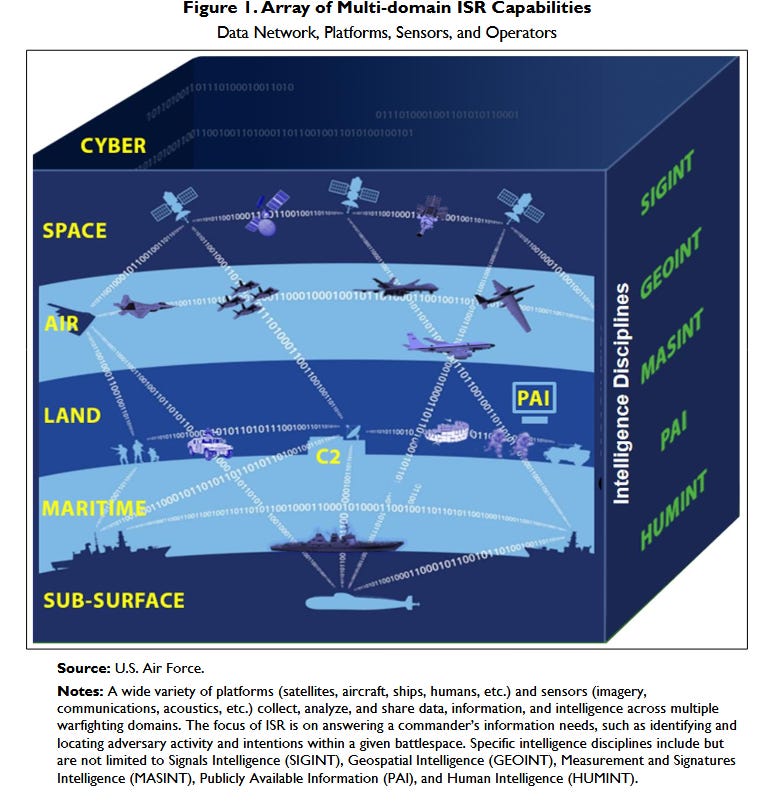
Writers throw panties at First-Person View (FPV) suicide drones these days—although that ‘tweenager crush is starting to get shaky—but they only work because of the expansion of the first part of the reconnaissance-strike complex (RSC). And don’t forget that movement and not just attrition dominance is the ultimate purpose of the RSC.
Recall the problems Ukraine has had when its military lost access to Starlink or American ISR assets. Those stories kept popping up over the course of the war and every time it was reported as a catastrophe for Ukrainian operations. And then after the ISR and communications were restored, the next day the wholesale flinging of panties at small, cheap drones would resume.
And the response has been figuring out how to shoot down the small, cheap drones with cheap air defenses. But should we be treating small suicide drones as if they are an air defense problem?
Small FPV drones arose because of a lack of artillery ammunition and air power. If the level of intelligence, surveillance, and reconnaissance (ISR) assets focused on the front had called in precision air power, precision artillery (tube and rocket) as well as precisely aimed dumb shells and bombs, would we even be talking about FPV drones in a RSC?
When speed of engagement and area lethality count, the Ukrainian Army has learned tube artillery is often a better solution than drones. Consider the facts. An artillery shell is a drone of sorts—an unsmart, intentionally self-destructive, one-way drone, but a drone that can get to the target quickly and is available 24/7, even in the worst weather. A Ukrainian officer recently told Western reporters that 12 Russian soldiers might take 12 drones to engage, which leads to several other things for Ukrainians and observant U.S. Army tacticians to think about. How often can an infantry company have a dozen drones constantly loitering over an enemy axis of advance? Have you got the drones and battery power to go 24/7? If the drones aren’t loitering, then it takes time—as in multiple minutes of precious time, as the enemy probe turns into an attack—to fly the drones to the suspected area of enemy advance. This scenario assumes recon drones have correctly identified the advance and not a feint. Even an average logistician ought to conclude that having one recon drone scout an area is much more cost-effective. So, the solution: support the recon drone with tube or rocket artillery.
Should we be trying to focus so much effort on shooting down those shells, bombs and rockets as we do FPV drones? We limit our efforts to trying to shoot down incoming anti-tank missiles with active protection systems (APS) on armored vehicles, especially tanks. But trying to knock down incoming precision rockets or shells isn’t attempted except on static bases. On the battlefield, other means are used to counter tactical capabilities. The small drone threat can be countered with other means—ideally area electronic counter-measures—but also RSC-enabled equivalents of counter-battery fire to suppress or destroy enemy drone units; and improved camouflage, deception, tactics, and procedures.
Improved armored vehicle passive protection and improved APS would cope with what is left that threats the armored combat vehicles.
First, the modern challenge in warfare’s information dimension is not one of scarcity but of abundance, synchronization, and dissemination. …
Second, the rotational brigade also has an array of sensors that must be denied the ability to collect on the OPFOR brigade tactical group (BTG). …
Third, the DTG possesses a litany of strike assets, but their employment must be precise and produce measurable effects for the DTG and subordinate BTGs. While the traditional definition of strike within a reconnaissance-strike regime refers to indirect fires capability, the Blackhorse Regiment possesses additional kinetic and nonkinetic means to strike a rotational brigade, including multispectrum jamming, psychological warfare and information operations, and cyberattacks.
While there is certainly a massive leap in battlefield information, I reject the idea that there is abundance rather than scarcity. What we have is much more than we used to have. Which is impressive. That is a common development over time as the means of getting information has expanded. Consider this observation:
Information was the departure point. “Today,” wrote the anonymous author, “there are more eyes on the enemy.” Even more important, what they saw could be immediately and effortlessly reported over great distance. New technologies were lifting the fog of war, replacing it with secure knowledge. It was no longer possible, to give just one example, to hide that old tactical staple, the 4-5 km per hour infantry flank march. At the present time, troops could be photographed, wrote the author; very soon television technology would be available. In union with long-range reconnaissance aircraft, television would give the commander even more certitude about enemy dispositions and intentions.
That was written in 1935 in Germany (Robert M. Citino, Blitzkrieg to Desert Storm, p. 26). How many commanders in World War II felt much certitude about enemy dispositions and intentions with their newer ISR technology? By Korea that was surely solved, right? By Vietnam? Well no doubt the high tech Desert Storm had that. Over Kosovo in 1999? I could go on, but will spare you at long last.
Russians didn’t have enough information to anticipate the Ukrainian offensive (raid that got out of hand?) into Kursk in their surprise August 2024 attack—and the Ukrainians attacking didn’t even know what they didn’t know!
I just don’t think a future of what we think is a transparent battlefield that makes war a pure battle of attrition like two machines operating within predictable design parameters grappling with each other will ever really arrive. The human mind will always be vulnerable to drawing the wrong conclusion. Any three accurate dots can form a picture even in the chaos of war, eh? And I doubt AI will be able to eliminate that weakness.
We get used to whatever level of information we have and realize how much information we don’t have. Perhaps one should say that sifting the raw data fire hose for enough usable information. But I have no doubt that once we achieve that capability we will find we don’t have enough of that sifted information, too.
The potential shortage of information is supported by the second challenge of denying the enemy’s sensors freedom to provide the enemy with information. If we can degrade or interrupt enemy sensors, they can do that to us. When we are used to a certain level of information, our commanders will consider that degraded level a scarcity—even if it would seem like a God’s eye view a generation earlier.
Finally, the information has to be used. The ability to exploit it quickly with secure communications to open opportunities for maneuver is a problem now. Delivering effects (not just fires)—accurately and quickly—will be important to achieving that maneuver opportunity by destroying, degrading, immobilizing, and confusing the enemy forces.
That of course is the black box of effects that I occasionally drone on about. When forces in contact need an enemy force taken out of the fight, the unit in contact must be able to request that result and not need to care where the effect comes from or what effect to request is. The black box should be able to determine what effect is needed from what is available at that moment for achieving what the unit in contact needs to accomplish its mission.
Fires enable movement and movement enables improved fires opportunities. A virtuous battlefield cycle is then possible.
Volume of fires has never been the major impediment to military operations. Shortages will eventually be overcome with more production or alternatives. Without the persistent surveillance of the battlefield and the ability to communicate with strike assets to rapidly strike identified targets, small FPV drones would be toys. Toys that take up too much of a combat unit’s effort. General Heinz Guderian recognized (at the time of that anonymous German author), as Citino summarized (p. 27), “The tank-aircraft-radio marriage was yet another form of combined arms.”
More fires and effects, the addition of air power (of whatever type), and new loitering sub-munitions will exploit the ISR web more effectively than slow, manpower-intensive FPV drones can.
And mobile, protected firepower—however we design “tanks” to provide that—able to provide the timely fires (or effects)—with secure communications will be the key to combined arms warfare (call it multidomain operations if you must, as long as it means a much broader form of combined arms).
And accept that commanders in contact will never have enough information. Especially at the most dangerous moments in combat as the enemy degrades your information collection and your communications.