


As we seek designs to keep tanks as the mobile, protected firepower that provides movement on a battlefield, we should contemplate much different design philosophies. I suspect that tanks need to be able to contribute to the shaping fight with indirect fire capabilities before being committed to closing with and destroying the enemy in a war of movement. Otherwise, expensive tank formations could become useless for large parts of a campaign, simply hiding and waiting for their moment.
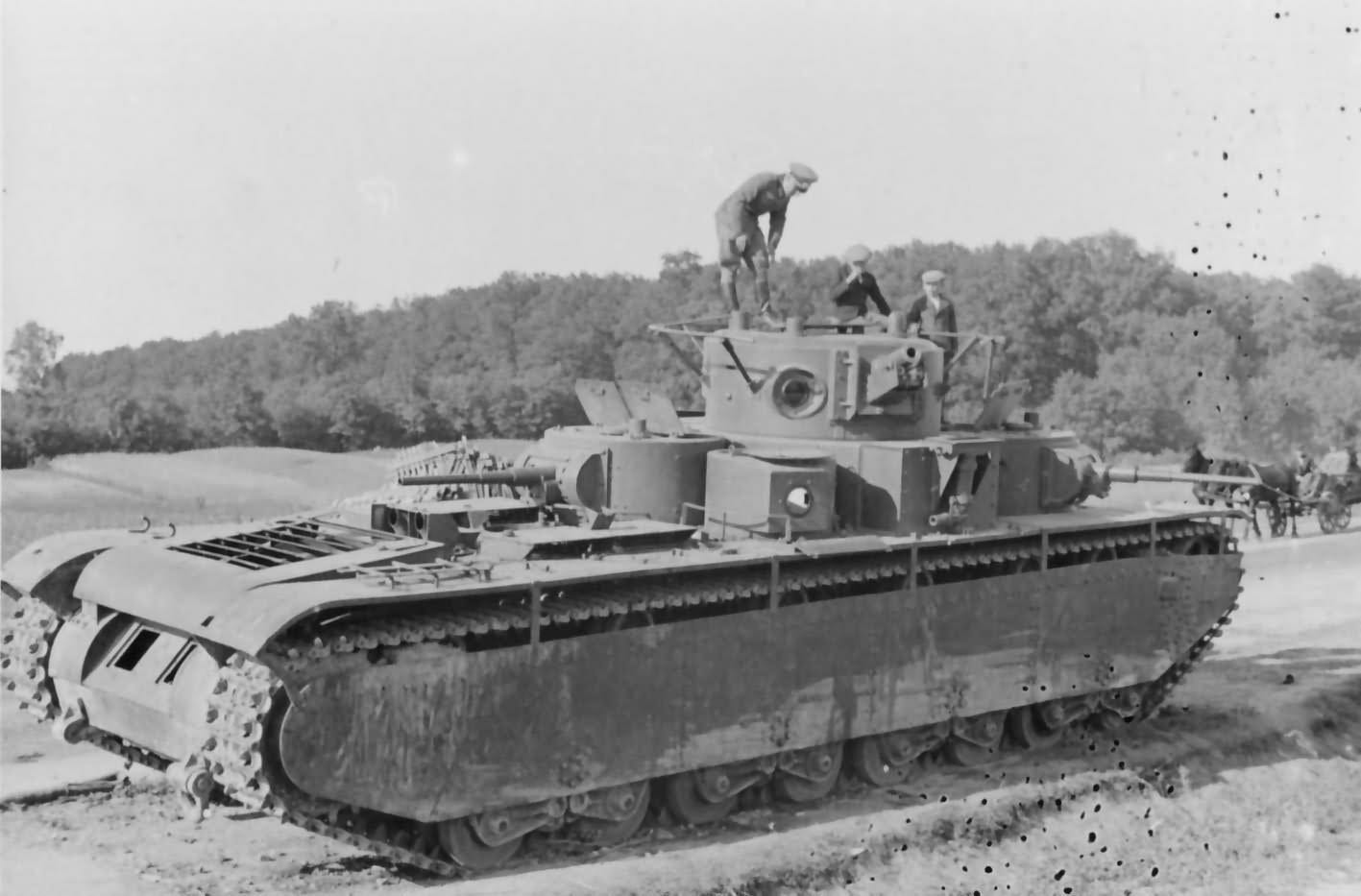
Remember the Russian T-35 heavy tank?
The T-35 was a Soviet multi-turreted heavy tank of the interwar period and early Second World War that saw limited service with the Red Army. Often called a land battleship, it was the only five-turreted heavy tank in the world to reach production, but proved to be slow and mechanically unreliable.
It was the most extreme of the multi-cannon tanks of the era. Few were produced after settling on a final design:
The serial tanks had a crew of 10 (commander, gunner and loader of the 76 mm turret, two gunners and loaders of the 45 mm turrets, two gunners of the machine gun turrets and the driver), still with two attached mechanics, making the total crew 12.
That fad fell away as tank design evolved to the main battle tank with a single large turret with a large-caliber cannon.
But will the experience of the Winter War of 2022 make that old design philosophy appropriate for new conditions? Tanks don’t face tanks as much as they are designed for. More often they provide fire support for infantry and face lighter armored vehicles or soft vehicles. And excessive exposure near the front for these expensive machines risks detection by increasingly persistent recon and targeting assets and subsequent attack from direct-fire weapons, artillery, and of course armed or suicide aerial drones.
I think tanks may need to use terrain and range for added protection instead of more massive passive armor to avoid detection and survive. Where heavy passive armor is retained, it would focus on crew protection, with the crew stationed in the hull. And I think the tank will need indirect fire capability to contribute to the shaping fight to restore opportunities for movement.
This capability set can be achieved with tank carrying a large indirect fire cannon as well as a smaller cannon for more numerous likely targets in direct fire combat that would be a waste of a cannon shell. Plus a smaller weapon for destroying suicide drones, extending protection beyond the Active Protection System (APS) and reactive armor that will dominate tank protection.
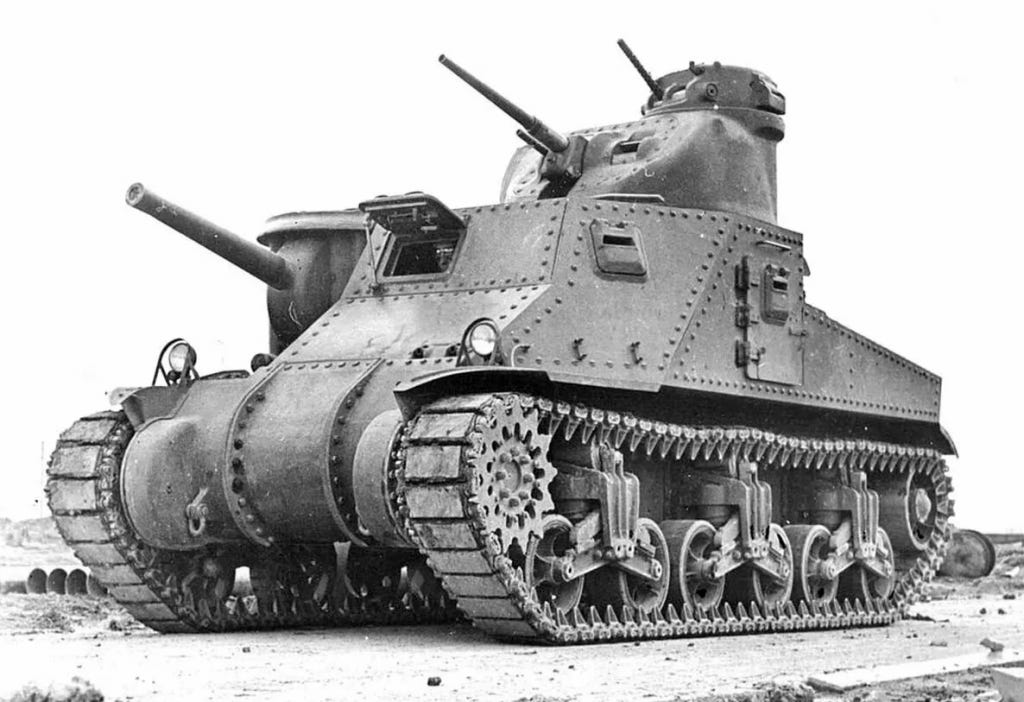
Rather than the T-35 design focus on direct fire, perhaps the replacement for the Abrams will abandon upgrades to and evolution of the Abrams design and instead draw inspiration from America’s old M3 Lee tank:
The design was unusual because the main weapon – a larger caliber, medium-velocity 75 mm gun – was in an offset sponson mounted in the hull with limited traverse. The sponson mount was necessary because, at the time, American tank plants did not have the design experience necessary to make a gun turret capable of holding a 75 mm weapon. A small turret with a lighter, high-velocity 37 mm gun sat on top of the tall hull. A small cupola on top of the turret held a machine gun.
A modern version would have a large cannon in the 120mm to 140mm range in the hull primarily for indirect fire with precision shells (including a SADARM-style guided anti-tank shell), a 40mm to 50mm auto-cannon in a turret for direct fire, and a 360 degree small auto-cannon or heavy machine gun for anti-drone fire, in place of the 75mm gun, 37mm gun, and machine gun of the Lee, respectively.
The auto-cannon would need AI aiming to hit near the same point repeatedly for direct fire against more heavily armored targets. By hitting the same point, repeatedly, all those charts showing armor piercing capability of shells get thrown out the window. Hitting the same point again and again even with a large auto-cannon will defeat thick passive armor, a means not possible without such accuracy.
Perhaps the sponson mount for the indirect fire weapon will make it easier than mounting the big cannon in a turret in order to allow for sufficient barrel elevation. And with precision guided rounds, precise aiming of the cannon isn’t necessary, making turning the tank sufficient rather than the fine pointing of using a turret.
I’d leave the area artillery fire with dumb shells to actual dedicated artillery units. The point of a dual purpose tank is to supplement artillery units in the shaping fight—not replace them. The tank’s primary role as mobile, protected firepower will still be to close with and destroy the enemy, and push into the enemy’s rear areas to cause cascading losses and confusion on the enemy.
Of course, you should upgrade this design by adding to the tank some tube-launched suicide First-Person View (FPV) drones for shorter range non-line of sight missions and—as the technology advances—a couple “wingman” armed, unmanned ground vehicles to take point for first contact. The tank’s large auto-cannon and cannon would provide overwatch while the wingmen advance. Tank-controlled FPV drones would support the wingmen advancing to close combat. But the basic tank could still fight while waiting for resupply of destroyed UGVs and FPV drones to restore full capabilities.
Could the small auto-cannon have a dual role as an APS in addition to counter-drone capability? The AbramsX has both APS and a 30mm chain gun Remote Weapon Station for lightly armored targets, with anti-drone capabilities, too. And the tank would need a variety of passive protection and electronic counter-measures against enemy FPV drones. Plus cameras and sensors for 360 degree view outside the tank.
Is this the image of the future tank? Larger, naturally. And without the rivets, of course.
It would not look like the modern main battle tank that the tank has evolved into during and after the Cold War. If it preserves mobile, protected firepower on the battlefield, why not?